



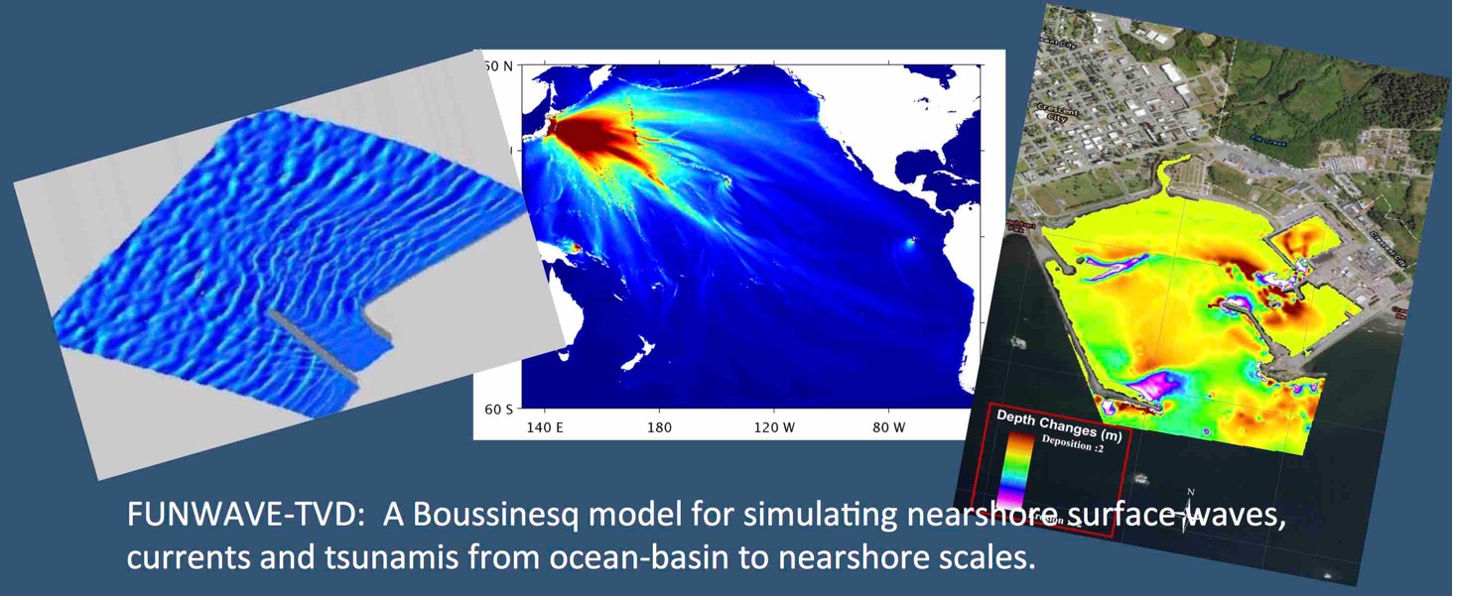
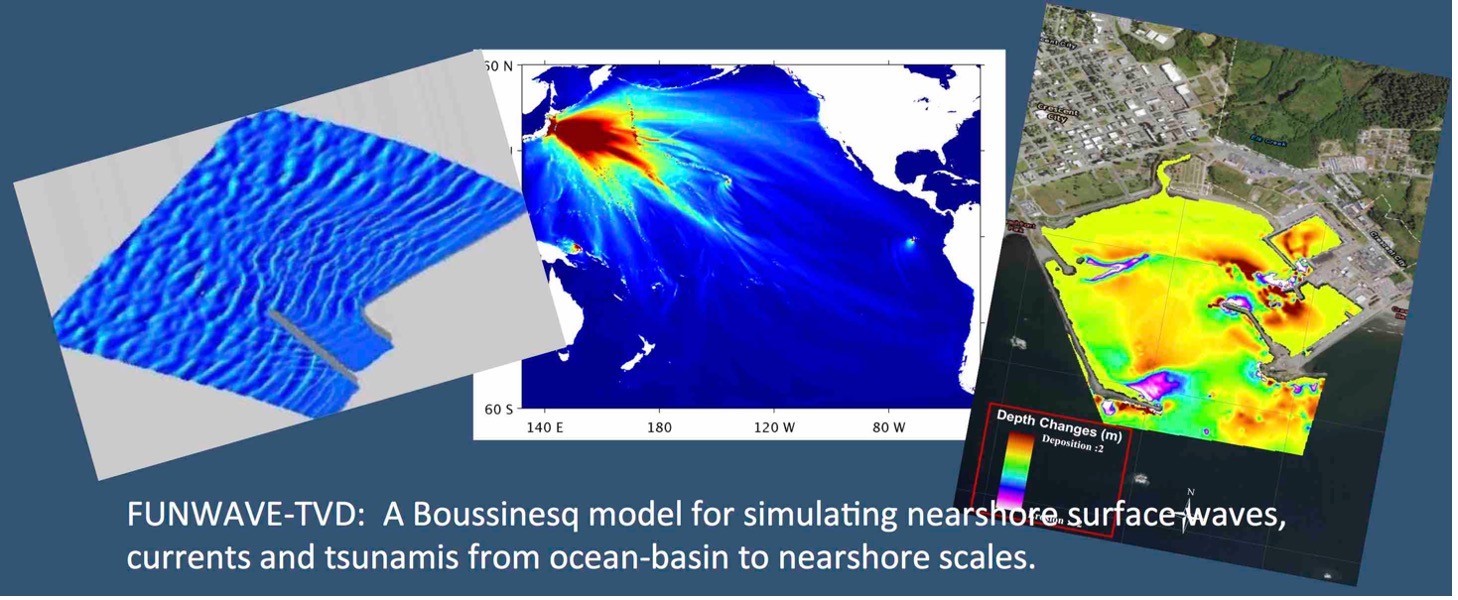
FUNWAVE–TVD is the Total Variation Diminishing (TVD) version of the fully nonlinear Boussinesq wave model (FUNWAVE) developed by Shi et al. (2012). The FUNWAVE model was initially developed by Kirby et al. (1998) based on Wei et al. (1995). The development of the present version was motivated by recent needs for modeling of surfzone–scale optical properties in a Boussinesq model framework, and modeling of Tsunami waves in both a global/coastal scale for prediction of coastal inundation and a basin scale for wave propagation.
FUNWAVE–TVD is both the approved and recommended U.S. Army Corps of Engineers (USACE) numerical Boussinesq wave model, funded by both Civil Works (CW) research programs (Navigation Systems and Flood and Coastal Systems). In addition, it is supported by the Coastal Working Group (CWG) and the Hydrology, Hydraulics, and Coastal (HH&C) USACE communities of practice (CoP).
Key features of FUNWAVE-TVD:
- A more complete set of fully nonlinear Boussinesq equations
- Monotonic Upwind Scheme for Conservation Laws (MUSCL)–TVD solver with adaptive Runge-Kutta time stepping
- Shock–capturing wave breaking scheme
- Wetting–drying moving boundary condition with incorporation of Harten-Lax-van Leer (HLL) construction method into the scheme
- Lagrangian tracking
- Option for parallel computation
- Ship-wake generation
- Meteo-tsunami generation
Sediment transport and morphological changes
FUNWAVE-TVD
The current version of FUNWAVE-TVD is Version 3.6 (as of March 2023)
Keywords:
FUNWAVE, FUNWAVE-TVD, hydrodynamic, ocean, coastal, storm surge, coupled, transport, inundation, 2D, 3D, hydrostatic, vessel, vessel wake, sediment, tsunami, Boussinesq
Email to USACE POC
FUNWAVE-TVD is free software: you can redistribute it and/or modify it under the terms of the Simplified BSD License as released by Berkeley Software Distribution (BSD).
The FUNWAVE-TVD source code is maintained within a version control repository on GitHub and available at https://github.com/fengyanshi/FUNWAVE-TVD.
For USACE, a WebUI interface is available at https://portal.erdc.hpc.mil/ for running the FUNWAVE-TVD model on ERDC HPCs.
The FUNWAVE-TVD GitHub Pages: https://fengyanshi.github.io/ has information of how to use FUNWAVE-TVD, the model theory, and some simple example problems.
The latest version of FUNWAVE-TVD is available on GitHub, https://github.com/fengyanshi/FUNWAVE-TVD.
A FUNWAVE-TVD Google group is available to join to post any questions about FUNWAVE-TVD, https://groups.google.com/g/funwave-tvd.
For USACE users, video tutorials on using FUNWAVE-TVD on the HPC portal are available from https://www.youtube.com/channel/UCIWsla9RSOGaxoVFExGuK_w.
Waves at Norfolk by Chris Lashley
Waves and runup at Norfolk by Chris Lashley
Waves and foam at FRF Duck NC
OSU lab: solitary wave runup on conical island
Lloyd and Stansby (1997) experiments
Spectral waves at Ponce de Leon Inlet
Ship wakes in Galveston Navigation Channel
Tsunami waves and nearshore morphological changes
Waves and inundation at South Betheny
More videos are available on Fengyan Shi’s YouTube channel: https://www.youtube.com/@fengyanshi4075/videos
Recent USACE Reports
- M. Malej et al. FUNWAVE-TVD Testbed Analytical, Laboratory, and Field Cases for Validation and Verification of the Phase- Resolving Nearshore Boussinesq-Type Numerical Wave Model Engineer Research and Development Center FUNWAVE-TVD Testbed Analytical, Laboratory, and Field Cases for Validation and Verification of the Phase- Resolving Nearshore Boussinesq-Type Numerical Wave Model. ERDC/CHL TR-24-12. http://dx.doi.org/10.21079/11681/49183.
- M. J. Torres et al. Getting started with FUNWAVE-TVD: troubleshooting guidance and recommendations. ERDC TN 24-5. Hanover, NH: US Army Engineer Research and Development Center. http://dx.doi.org/10.21079/11681/48631.
- M. J. Torres et al. Practical Guidance for Numerical Modeling in FUNWAVE-TVD. ERDC/ TN-22-1 ERDC TN-22-1. Hanover, NH: US Army Engineer Research and Development Center–Cold Regions Research and Engineering Laboratory. http://dx.doi.org/10.21079/11681/45641.
- M. Malej and F. Shi. Suppressing the Pressure-Source Instability in Modeling Deep-Draft Vessels with Low Under-Keel Clearance in FUNWAVE-TVD. ERDC/CHL CHETN-IX-55. http://dx.doi.org/10.21079/11681/40639.
- M. Y. Lam, M. Malej, and F. Shi. “Operational Modeling of Large Container Type-Vessel-Generated Waves with Related Erosion and Scour Effects”. ERDC/CHL TR-22-20. http://dx.doi.org/10.21079/11681/45483
- M. Malej, F. Shi, and J. M. Smith. “Modeling Ship-Wake-Induced Sediment Transport and Morphological Changes – Sediment Module in FUNWAVE-TVD”. ERDC/CHL CHETN-VII-20. http://dx.doi.org/10.21079/11681/32911.
Recent Journal Publications
- Malej, M. & Fengyan Shi (2024). Modeling the optical signature induced by surfzone bubbles using the Boussinesq-type wave model FUNWAVE-TVD. Ocean Engineering, 307(118160). http://dx.doi.org/10.1016/j.oceaneng.2024.118160
- Lashley, C., Puleo, J., & Shi, F. (2022). The contribution of wave runup to coastal flooding at Norfolk (VA, USA) during extreme events. Costal Engineering Proceedings, 37, management.21. http://dx.doi.org/10.9753/icce.v37.management.21
- Everett et al. (2022). Ship wake forcing and performance of a living shoreline segment on an estuarine shoreline. Frontiers in Built Environment. http://dx.doi.org/10.3389/fbuil.2022.917945.
- Sun, Q. et al. (2022). Runup of landslide-generated tsunamis controlled by paleogeography and sea-level change. Communications Earth& Environment, 3(224). http://dx.doi.org/10.1038/s43247-022-00572-w
- Forlini, C. et al. (2021). On the Problem of Modeling the Boat Wake Climate: The Florida Intracoastal Waterway. Journal of Geophysical Research: Oceans, 126(2), e2020JC016676. https://doi.org/10.1029/2020JC016676
- Shi, F.; Malej, M.; Smith, J. M.; & Kirby, J. T. (2018). Breaking of Ship Bores in a Boussinesq-type Ship-Wake Model. Costal Engineering 132(2018): 1-12. https://doi.org/10.1016/j.coastaleng.2017.11.002
- Woodruff, I., Kirby, J., Shi, F., & Grilli, S. (2018). Estimating Meteo-Tsunami Occurrences for the US East Coast. Coastal Engineering Proceedings, 1(36), currents.66. https://doi.org/10.9753/icce.v36.currents.66
- Shi, F. et al. (2012). A High-Order Adaptive Time-Stepping TVD Solver for Boussinesq Modeling of Breaking Waves and Coastal Inundation. Ocean Modelling 43(2012): 36-51. https://doi.org/10.1016/j.ocemod.2011.12.004
Currently, no Community Test Cases are available.
Currently, no Software Revision Discussion is available.