



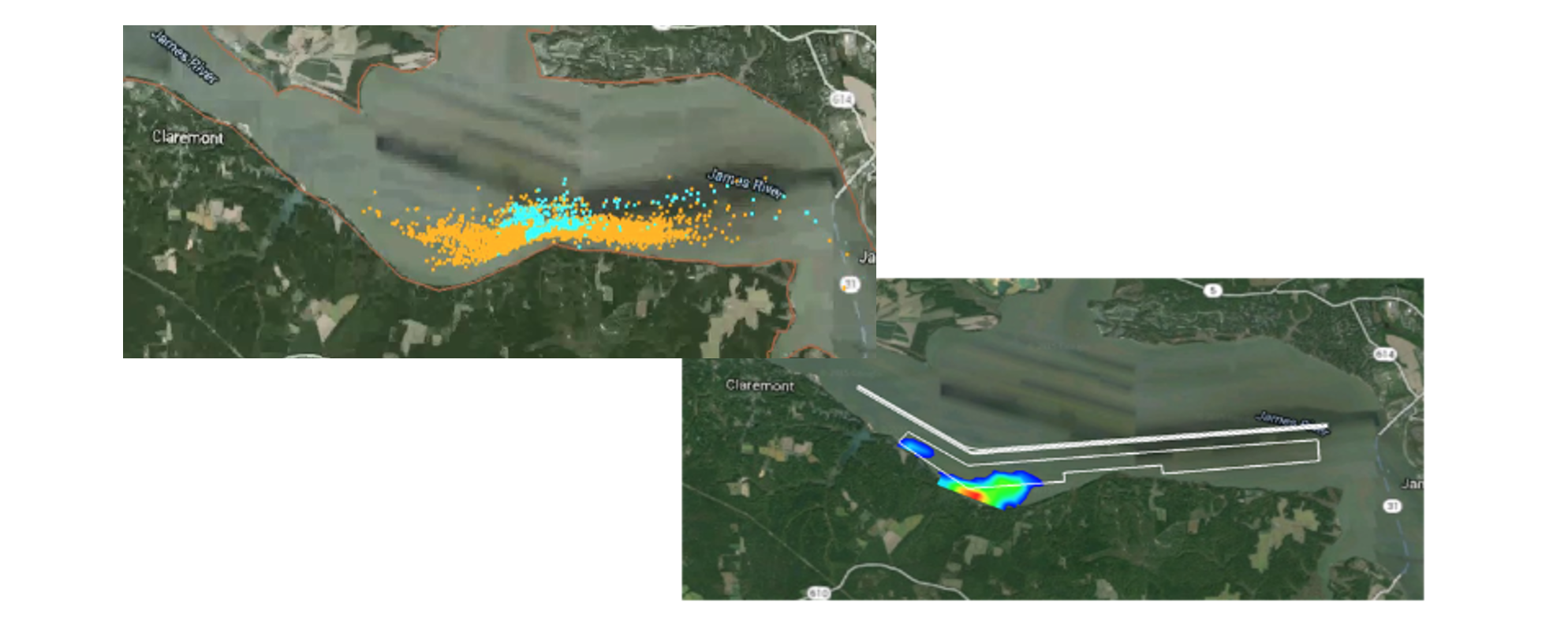
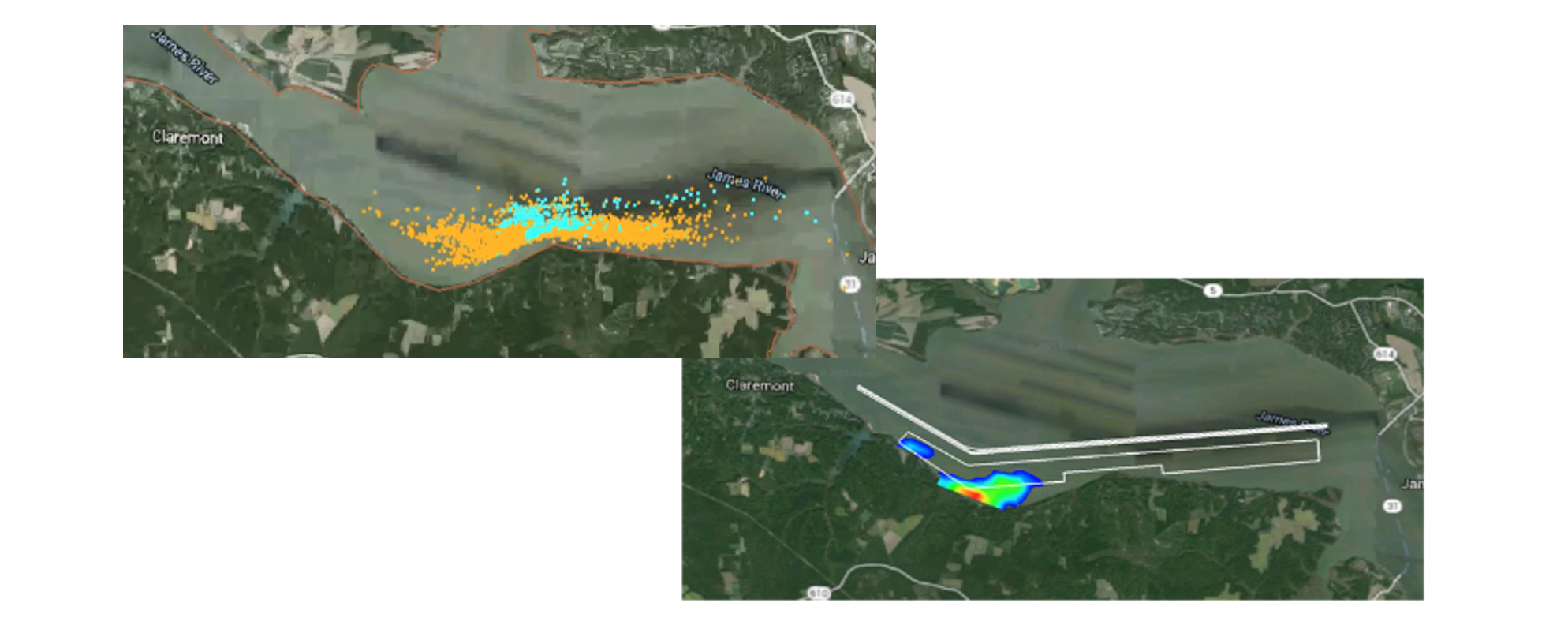
The Particle Tracking Model (PTM) is a Lagrangian particle tracker designed to allow the user to simulate particle transport processes. PTM has been developed for application to dredging and coastal projects including dredged material dispersion and fate, sediment pathway and fate, and constituent transport. The model contains algorithms that appropriately represent transport, settling, deposition, mixing, and resuspension processes in nearshore wave/current conditions. It uses waves and currents developed through other models and input directly to PTM as forcing functions. PTM Version 2.0 operates in the Surface-water Modeling System (SMS) interface (v10.1). The model is funded through two ERDC research programs, the Coastal Inlets Research Program (CIRP) and the Dredging Operations and Environmental Research (DOER) Program.
Capabilities and Benefits of PTM:
- Transport of multiple sediment types
- Models specific source types
- Efficient modeling allows multiple scenarios
- Visualization is user friendly with SMS interface
- Sediment pathways are easy to identify
- Post processing items like concentration, deposition, etc.
- Model can be used any complex hydrodynamic and wave environments
Keywords:
PTM, Lagrangian, particle tracking, dredging, risk assessment, sediment, larval fish, resuspension, sediment modeling, residence time
The PTM modeling software is in general available for use by academic and government researchers at no charge for research and educational purposes. The modeling software is available for purchase for all others.
The PTM source code is maintained within a version control repository on GitHub and is account access restricted. Email (link to PTM model POC) for additional details about obtaining access to source code.
A graphical user interface for PTM is part of the Surfacewater Modeling System (SMS). For USACE users, SMS is available from the ACE-IT App Portal. SMS is also available for download from https://www.aquaveo.com/software/sms-surface-water-modeling-system-introduction .
The PTM Website: https://doer.el.erdc.dren.mil/ptm.html has information of how to use ADCIRC including online User’s Guides and the model theory discretization reports.
A PTM/SMS Wiki page is also available with additional information at https://www.xmswiki.com/wiki/SMS:PTM
Recent USACE Reports
- Lackey, T.C., Bailey, S., Gailani, J., Kim, S-C., and Schroeder, P. 2019a. Hydrodynamic and Sediment Transport Modeling for James River Dredged Material Management. ERDC/CHL Technical Report TR-0X-X. U.S. Army Engineer Research and Development Center, Vicksburg, MS. http://dx.doi.org/10.21079/11681/38255
- Li, Honghai & LACKEY, TAHIRIH & Beck, Tanya & MORITZ, HANS & GROTH, KATE & Puckette, Trap & Marsh, Jon & Blumberg, Alan. (2018). Field Measurements, Sediment Tracer Study, and Numerical Modeling at Coos Bay Inlet, Oregon.
Recent Journal Publications
- Shafer, Deborah & McManus, John & Richmond, Robert & King, David & Gailani, Joe & Lackey, Tahirih & Bryant, Duncan. (2015). Predicting dredging-associated effects to coral reefs in Apra Harbor, Guam - Part 2: Potential coral effects. Journal of environmental management. 168. 111-122. http://dx.doi.org/10.1016/j.jenvman.2015.10.025
Gailani, J. Z., T. C. Lackey, D. B. King, D. Bryant, S.-C. Kim, and D. J. Shafer. 2016. “Predicting Dredging-Associated Effects to Coral Reefs in Apra Harbor, Guam—Part 1 Sediment Exposure Modeling.” Journal of Environmental Management 168(1 March 2016): 16–26. https://doi.org/10.1016/j.jenvman.2015.10.027
Currently, no Community Test Cases are available.
This space is intended to be used to describe code modifications since the last release, including bug fixes and possible impacts of those bugs to the code results.