



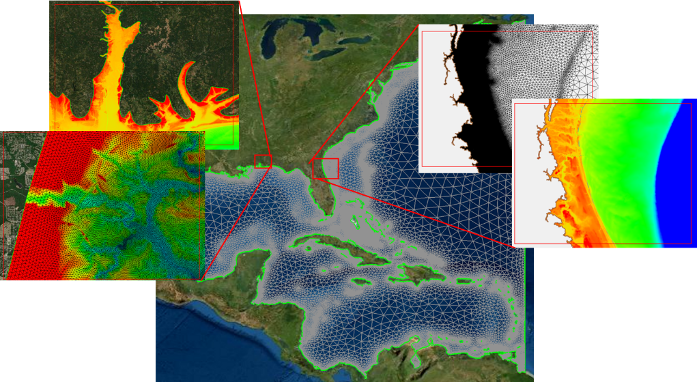
ADCIRC is a hydrodynamic modeling technology that conducts short- and long-term simulations for water surface elevations and currents in deep oceans, continental shelves, coastal seas, small-scale estuarine systems and even large lakes. It is particularly useful for evaluating engineering designs of coastal flood risk management projects including Engineering with Nature (EWN), natural and nature-based features. ADCIRC is typically used as a two-dimensional depth integrated (2DDI) model but is also available as a three-dimensional (3D) model, to solve time dependent, free surface circulation and transport problems using a form of the shallow water equations. ADCIRC is a finite element model that uses unstructured triangular shaped elements to discretize the model domain. ADCIRC is optimized for parallel computing on high performance computers (HPCs) and is typically used for storm surge and tidal circulation modeling.
Key features of ADCIRC:
- Unstructured mesh allows for high localized resolution where solution gradients maybe large, and lower grid resolution where solution gradients are small, minimizing both local and global error norms for a given computational cost
- Small or large computational domains are possible. Large domains eliminate the need for imposing approximate open-water boundary conditions that can create inaccuracies in model results, while simultaneously providing high resolution in areas of complex shoreline and bathymetry where it is needed to maximize simulation accuracy
- Wetting/drying (inundation/recession) of low-lying areas
- Overflow/throughflow barriers and bridge piers
- Riverine, Wind, atmospheric pressure, and wave radiation stress forcings to drive the model
- Salinity and contaminant transport modeling
- Spatially varying nodal attributes such as “Manning’s n”, “Surface Canopy” and “Surface Directional Roughness” values that allow for model parameterizations based on land cover and land use maps
- Compliant for model coupling via the Earth System Modeling Framework (ESMF)
Keywords: ADCIRC, hydrodynamic, circulation, ocean, coastal, storm surge, coupled, transport, tides, inundation, 2D, 3D, baroclinic, barotropic, hydrostatic
The ADCIRC modeling software is in general available for use by academic and government researchers at no charge for research and educational purposes. The modeling software is available for purchase for all others.
The ADCIRC source code is maintained within a version control repository on GitHub and is account access restricted. Email (link to ADCIRC model POC) for additional details about obtaining access to source code.
For USACE use, a Microsoft Window’s executable is included with the Surfacewater Modeling System (SMS) that is available from the ACE-IT software portal. In addition, model executables are maintained on several of the Department of Defense (DoD) High Performance Computing (HPC) systems. Email (link to ADCIRC model POC) for additional information on using ADCIRC on DoD HPCs.
A graphical user interface for ADCIRC is part of the Surfacewater Modeling System (SMS). For USACE users, SMS is available from the ACE-IT App Portal. SMS is also available for download from https://www.aquaveo.com/software/sms-surface-water-modeling-system-introduction .
Recent USACE Reports
- T.C. Massey, T. Lackey, and M. Owensby. “ADCIRC Circulation and Particle Tracking Modeling for Proposed St. Jerome Creek Inlet Jetties”. ERDC/CHL LR-21-15. http://dx.doi.org/10.21079/11681/41820.
- T.C. Massey, M. Owensby, L. Provost, M. Bryant, T. Hesser, A. Tritinger, C. Dillon, J. Goertz, and Y. Ding. Calibration and Validation of the Coastal Storm Modeling System (CSTORM-MS) Setup for the South Atlantic Domain of the South Atlantic Coastal Study (SACS). ERDC/CHL LR 21-4, April 2021.
- T.C. Massey, M. Owensby, L. Provost, C. Dillon, T. Hesser, A. Tritinger, M. Bryant, J. Goertz, and E. Godsey. Calibration and Validation of the Coastal Storm Modeling System (CSTORM-MS) for the South Atlantic Coastal Study (SACS) in the Gulf of Mexico. ERDC/CHL LR 21-3, April 2021.
- M. Owensby, M. Bryant, T. Hesser, L. Provost, T.C. Massey, and Y. Ding, “Calibration and Validation of the Puerto Rico/U.S. Virgin Island Domain Model Setup for the South Atlantic Coastal Study (SACS)”; ERDC/CHL LR-19-09, December 2019.
Recent Journal Publications
- Blakely, C. P., Ling, G., Pringle, W. J., Contreras, M. T., Wirasaet, D., Westerink, J. J., et al. (2022). Dissipation and Bathymetric sensitivities in an unstructured mesh global tidal model. Journal of Geophysical Research: Oceans, 127(5), e2021JC018178. https://doi.org/10.1029/2021jc018178
- Bunya, S., Dietrich, J. C., Westerink, J. J., Ebersole, B. A., Smith, J. M., Atkinson, J. H., et al. (2010). A high-resolution coupled riverine flow, tide, wind, wind wave, and storm surge model for southern Louisiana and Mississippi. Part I: Model development and validation. Monthly Weather Review, 138(2), 345– 377. https://doi.org/10.1175/2009MWR2906.1
- Kerr, P. C., Martyr, R. C., Donahue, A. S., Hope, M. E., Westerink, J. J., Luettich, R. A., Jr., et al. (2013). U.S. IOOS coastal and ocean modeling testbed: Evaluation of tide, wave, and hurricane surge response sensitivities to mesh resolution and friction in the Gulf of Mexico. Journal of Geophysical Research: Oceans, 118(9), 4633– 4661. https://doi.org/10.1002/jgrc.20305
N/A
The ADCIRC developers’ and users’ community has an ever-increasing suite of test cases intended to verify and validate the numerical code integrity. The included suite of tests, over 30 cases at present, has been developed to test changes to the ADCIRC model and ensure solutions are consistent across releases. This suite is run any time a change is made to the model code and the new code must pass all tests before the code is allowed to be integrated into the upstream repository of the ADCIRC code. The test cases are available via public access at Github: https://github.com/adcirc/adcirc-testsuite . Descriptions of the different test cases are available on the Github site along with instructions for running them. These test cases also can serve as instructional examples of different ADCIRC model parameter settings.