



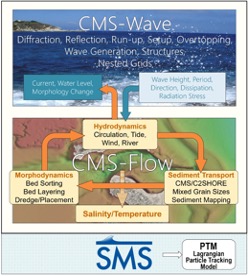
The CMS is an integrated depth-averaged (2D) numerical modeling system. Two major components of the CMS are the CMS-Flow and CMS-Wave models. CMS-Flow solves the conservative form of the shallow water equations and calculates sediment transport by a non-equilibrium advection-diffusion sub-model using the finite volume method. CMS-Wave is a spectral wave transformation model. The finite difference method is used to solve the steady-state wave-action balance equation. Both models are discretized and solved on a non-uniform Cartesian grid and the CMS-Flow model is also characterized by the feature of a quadtree grid representation. The CMS is developed for simulating waves, currents, water levels, sediment transport and morphology change, and salinity and temperature, and is applied for evaluation of navigation channel performance and calculation of sediment exchange between inlets and adjacent beaches.
Key features of the CMS:
- PC-based, easy-to-use, accurate, and efficient
- Two solvers are implemented in the CMS-Flow code. The implicit solver uses the SIMPLEC algorithm on a non- staggered grid. The explicit solver uses a staggered grid with velocities at cell faces and the water levels and water depths at cell centers. The discretization scheme has been proven highly successful in approximating the solution of a wide variety of conservation law systems in integral control volume form.
- High resolution short- (weeks) to mid/long-term (seasonal to multiple years) project scale simulations
- Eulerian sediment tracer and Lagrangian particle tracking simulations
- Representation of a wide range of nearshore physical processes, such as wetting and drying, advection, diffusion, turbulent mixing, tides, waves, wave-current interaction, freshwater inflows, wind, atmospheric pressure, evaporation and precipitation, air-water heat exchange, multiple-sized sediment transport, bed sorting, and morphology change
- Representation of coastal structures, weirs, culverts, porous rubble mounds, and tidal gates, and channel dredge/placement operations
- Shallow water processes in the CMS-Wave model includes wave shoaling, refraction, diffraction, reflection, wind wave generation and growth, dissipation due to bottom friction, white-capping and breaking, wave-current interaction, wave runup, wave setup, and wave transmission through structures
- Surf zone and swash zone dynamics
- The Surface-water Modeling System (SMS) provides the dynamic coupling interface between CMS-Flow and CMS-Wave, which is also used for data preprocessing, grid generation, model setup, and post-processing of modeling results, and provides the linkage between the CMS driving forces and the Lagrangian Particle Tracking Model (PTM).
- Identified by the USACE Hydraulics and Hydrology - Coastal Community of Practice (CoP) as a Preferred model for Coastal Engineering and Coastal Navigation studies
Keywords:
CMS, hydrodynamics, tide, current, waves, coastal, nearshore, surf zone, inlet, beach, estuary, ocean, sediment transport, morphology, structures
The CMS modeling software is publicly available for use by everyone.
At present, the CMS source code is maintained within a private version control repository on GitLab (account access restricted). Email cirp@usace.army.mil for additional details about obtaining access to source code.
For USACE use, a Microsoft Window’s executable is included with the Surface-water Modeling System (SMS) that is available from the ACE-IT software portal. Additionally, windows executables can be obtained from our wiki page, https://cirpwiki.info/wiki/CMS_Releases
The CMS can be compiled to run on Linux and HPC systems. Email cirp@usace.army.mil for additional information on using CMS on these systems.
A graphical user interface for ADCIRC is part of the Surface-water Modeling System (SMS). For USACE users, SMS is available from the ACE-IT App Portal. SMS is also available for download from https://www.aquaveo.com/software/sms-surface-water-modeling-system-introduction .
The current release version of the is Version 5.3.2. (as of April 2023).
- The product page on the main CIRP website contains information on the latest versions and direct links to important topics, https://cirp.usace.army.mil/products/cms.php.
- Numerous wiki pages on the CIRP wiki. The main CMS page includes a documentation table pointing to many topics of interest, https://cirpwiki.info/wiki/CMS.
- Some additional documentation linked to the actual open-source version of the code can be found at https://cms2d.readthedocs.io/en/latest/.
Recent USACE Reports
- H. Li, M. Brown, L. Lin, Y. Ding, T. Beck, A. Sánchez, W. Wu, C. Reed, and A. Zundel. Coastal Modeling System User’s Manual. ERDC/CHL SR-24-3, April 2024. https://dx.doi.org/10.21079/11681/48392
- H. Li, L. Lin, C. Johnson, Y. Ding, M. Brown, T. Beck, A. Sánchez, and W. Wu. A revisit and update on the verification and validation of the Coastal Modeling System (CMS): report 1--hydrodynamics and waves. ERDC/CHL TR-22-18, September 2022. http://dx.doi.org/10.21079/11681/45444.
- H. Li, H. Berckenhoff, J. McMahon, and M. Wood. Hydrodynamic, Wave and Sediment Transport Modeling Around Third Port in Skiffes Creek and James River. ERDC/CHL LR 22-2, November 2021.
- H. Li, G. Maze, K. Conner, and J. Hazelton. Sediment transport modeling at Stono Inlet and adjacent beaches, South Carolina. ERDC/CHL TR 21-19, November 2021. http://dx.doi.org/10.21079/11681/42501.
- Z. Demirbilek, L. Lin, O. Nwogu, W. Cross, C. O’Connell, S. Chader, M. Mohr, G. Hintz, S. Hint, and M. Draganac. Design water levels and waves for repairs of Buffalo Harbor North and South Breakwaters and LaSalle Park Seawall, Buffalo, New York. ERDC/CHL TR-19-8, May 2019. http://dx.doi.org/10.21079/11681/33024.
- R. Style, M. Brown, K. Brutsche, H. Li, T. Beck, and A. Sánchez. Long-Term Morphology Modeling for Barrier Island Tidal Inlets. ERDC/CHL TR 18-12, July 2018. http://dx.doi.org/10.21079/11681/28013.
- H. Li, T. Lackey, T. Beck, H. Moritz, K. Groth, T. Puckette, and J. Marsh. Field measurements, sediment tracer study, and numerical modeling at Coos Bay Inlet, Oregon. ERDC/CHL TR 18-6, June 2018. http://dx.doi.org/10.21079/11681/27606.
- H. Li, M. Brown, T. Beck, A. Frey, J. Rosati, M. Habel, J. Winkelman, E. O’Donnell, and I. Watts. Merrimack Estuary and Newburyport Harbor sediment management studies. ERDC/CHL TR-18-7, June 2018. http://dx.doi.org/10.21079/11681/27405.
- D. King, M. Bryant, R. Style, T. Lackey, E. Smith, and R. Visperas. Brazos Santiago Inlet, Texas, shoaling study. ERDC/CHL TR-18-2, February 2018. http://dx.doi.org/10.21079/11681/26481.
Recent Journal Publications
- Li, H., Rucker, C., Lin, L., and Conner, K. 2024. Modeling Sediment Tracers to Evaluate Current and Sediment Plume at Beaufort Inlet, North Carolina. Journal of Waterway, Port, Coastal, and Ocean Engineering, 151(2). https://doi.org/10.1061/JWPED5.WWENG-2154.
- Holzenthal, E., Bain, R., Krafft, D., Cadigan, J., and Styles, R. 2024. Hydrodynamic Mechanisms and Pathways of Potential Navigation Channel Shoaling by Nearby Parallel Islands. Journal of Waterway, Port, Coastal, and Ocean Engineering, 151(1). https://doi.org/10.1061/JWPED5.WWENG-2127.
- Krafft, D. R., R. Styles, and M. E. Brown. 2022. Feedback between Basin Morphology and Sediment Transport at Tidal Inlets: Implications for Channel Shoaling. Journal of Marine Science and Engineering, 10(3): 442. https://doi.org/10.3390/jmse10030442.
- Johnson C. L., McFall B. C., Krafft D. R., M. E. Brown. 2021. Sediment Transport and Morphological Response to Nearshore Nourishment Projects on Wave-Dominated Coasts. Journal of Marine Science and Engineering, 9(11): 1182. https://doi.org/10.3390/jmse9111182.
- Li, H. 2021. Transport of placed dredged material in surf and nearshore Zone. J. Waterway, Port, Coastal, Ocean Eng. 147(3): 1-18. https://doi.org/10.1061/(ASCE)WW.1943-5460.0000624.
- Beck, T. M., P. Wang, H. Li, and W. Wu. 2020. Sediment Bypassing Pathways between Tidal Inlets and Adjacent Beaches. Journal of Coastal Research, 36(5), 897-914. https://doi.org/10.2112/JCOASTRES-D-19-00141.1.
- Li, H., T. M. Beck, H. R. Moritz, K. Groth, T. Puckette, and J. Marsh. 2019. Sediment Tracer Tracking and Numerical Modeling at Coos Bay Inlet, Oregon. Journal of Coastal Research, 35(1), 4-25. https://doi.org/10.2112/JCOASTRES-D-17-00218.1.
The CMS developer and user community have completed several validation and verification (V&V) runs and these test cases are available for users to download. We are gathering many smaller test cases to ensure our model continues to provide accurate solutions before any new release version of the code is provided to the public. Once those cases are collected and fully assessed, they will be made available to users as well.
The V&V cases we have are available at https://cirpwiki.info/wiki/CMS/ValidationTestCases
The CMS modeling software is publicly available for use by everyone.
At present, the CMS release code is designated as Open Source. This code is maintained within a public version control repository on GitHub (https://github.com/erdc/cms2d). Email cirp@usace.army.milfor additional details about the source code.
For USACE use, a Microsoft Windows executable is included with the Surface-water Modeling System (SMS) that is available from the ACE-IT software portal. Additionally, the Windows executable can be obtained from our wiki page, https://cirpwiki.info/wiki/CMS_Releases
The CMS can also be compiled to run on Linux and HPC systems. Email cirp@usace.army.milfor additional information on using CMS on these systems.
A graphical user interface for CMS is part of the Surface-water Modeling System (SMS). For USACE users, SMS is available from the ACE-IT App Portal. SMS is also available for download from https://www.aquaveo.com/software/sms-surface-water- modeling-system-introduction .
The current release version of the CMS is Version 5.4.4.3 (as of May 2025).
- Compatibility updates to work with SMS version 13.4 including all CMS-Flow structure types.
- Added boundary condition using extraction from a larger parent from within SMS 13.4
- Added CF descriptive data for most output solutions.
- Accepts a ‘—non-interactive’ flag as the last argument on the command line to avoid extra user keyboard input.
- CMS-Wave code is now fully dynamically allocated.
- Several changes to Flow and Wave code to generalize for Linux GNU Fortran compilation.
- Many bug-fixes