


The Hydrogeomorphic (HGM) Approach for Assessing Wetland Functions was developed by researchers at the Engineer Research and Development Center (ERDC) through the Wetlands Regulatory Assistance Program (WRAP). HGM is both a wetland classification scheme and a methodology for assessing the capacity of an ecosystem to perform functions. It is designed to assess wetland and aquatic ecosystems, which are normally characterized in terms of their structural components and the processes that link these components. Structural components of the ecosystem and the surrounding landscape, such as plants, soils, hydrology, and animals, interact with a variety of physical, chemical, and biological processes. Understanding the interactions of the structural components of the ecosystem with surrounding landscape features is the basis for assessing ecosystem functions, and is the foundation of the HGM Approach.
The HGM Approach assesses ecosystem function based on deviation of measured or estimated variables from reference standard sites. The assessment is designed to be applied rapidly, provide repeatable results, and conducted nearly any time of the year in keeping within cost, manpower, and time constraints, and without extensive specialized training or equipment of the agencies charged with assessing permit actions and project impacts. Instead of directly measuring ecosystem function, the approach employs indicators of community structure and process, aggregated into simple logic models, to indirectly reflect functionality.
Key features of HGM:
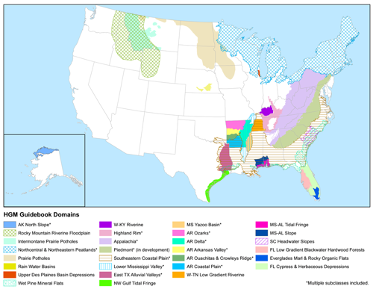
- Applicable to multiple geographic regions
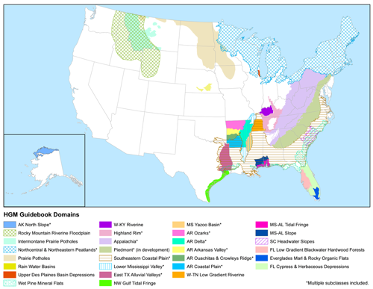
- Applicable to multiple classes of wetlands
- Rapid application with utility in multiple USACE mission areas and business lines (e.g., Regulatory, Planning, Aquatic Ecosystem Restoration)
- Can be used to characterize baseline info at impact and mitigation sites, determine mitigation requirements, identify ecological performance standards, and monitor and quantify success of restoration and mitigation projects
- Consistent procedures for model development, validation, and verification
Keywords:
HGM, wetlands, functional assessments, hydrodynamics, ecosystem restoration, planning, regulatory
USACE POC
Kyle Gordon (kyle.b.gordon@usace.army.mil)
HGM Guidebooks and associated FCI calculators are available for use by USACE, its Federal, State, and Tribal Partners, practitioners, and the public at https://wetlands.el.erdc.dren.mil/guidebooks.cfm
Email Kyle Gordon (kyle.b.gordon@usace.army.mil) for additional information on using HGM.
All HGM Guidebooks and FCI calculators are available at https://wetlands.el.erdc.dren.mil/guidebooks.cfm
[Place holder for link to USACE-developed video for HGM.]
Pertinent USACE Reports
- Berkowitz, J.F., Beane, N.R., Philley, K.D., and Ferguson, M. (2017). Operational Draft Regional Guidebook for the Rapid Assessment of Wetlands in the North Slope Region of Alaska, ERDC/EL TR-17-14, U.S. Army Engineer Research and Development Center, Vicksburg, MS
- Berkowitz, J. F., Noble, C. V., and Wilson, Z. M. (2014). Framework for the Data-Driven Geographical Expansion of Rapid Ecological Assessment Methods, ERDC TN-WRAP-14-1, U.S. Army Engineer Research and Development Center, Vicksburg, MS
- Smith, R. D., Noble, C. V., and Berkowitz, J. F. (2013). Hydrogeomorphic (HGM) Approach to Assessing Wetland Functions: Guidelines for Developing Guidebooks (Version 2), ERDC/EL TR-13-11, U.S. Army Engineer Research and Development Center, Vicksburg, MS.
- Smith, D. R., Ammann, A., Bartoldus, C., and Brinson, M. M. (1995). An approach for assessing wetland functions using hydrogeomorphic classification, reference wetlands, and functional indices, Technical Report WRP-DE-9, U.S. Army Engineer Waterways Experiment Station, Vicksburg, MS.
Pertinent Journal Publications
- Berkowitz, J. F. (2019). Quantifying functional increases across a large-scale wetland restoration chronosequence. Wetlands, 39(3), 559-573.
- Franklin, S. B., J. A. Kupfer, R. Pezeshki, R. Gentry, and R. D. Smith. (2009). Efficacy of the hydrogeomorphic model (HGM): A case study from western Tennessee. Ecological Indicators 9 (2):267-283.
- Price, J. J., & Berkowitz, J. F. (2020). Wetland functional responses to prolonged inundation in the active Mississippi River Floodplain. Wetlands, 40(6), 1949-1956.
In accordance with Smith et al. (2013), the final phases of assessment model development include the testing, calibration, and validation of all assessment models prior to publishing each HGM Guidebook.
Currently, no Software Revision Discussion is available.