


WAVEWATCH III® is a community wave modeling framework that includes the latest scientific advancements in the field of wind-wave modeling and dynamics.
The core of the framework consists of the WAVEWATCH III® third-generation wave model (WAVE-height, WATer depth and Current Hindcasting). WAVEWATCH III® differs from its predecessors in many important points such as governing equations, model structure, numerical methods and physical parameterizations
WAVEWATCH III® solves the random phase spectral action density balance equation for wavenumber-direction spectra. The implicit assumption of this equation is that properties of medium (water depth and current) as well as the wave field itself vary on time and space scales that are much larger than the variation scales of a single wave. The model includes options for shallow-water (surf zone) applications, as well as wetting and drying of grid points. Propagation of a wave spectrum can be solved using regular (rectilinear or curvilinear) and unstructured (triangular) grids.
Key features of WW3:
- Third generation wave model
- Updated wave breaking and triad interactions to better resolve nonlinear energy transfer through the surf zone
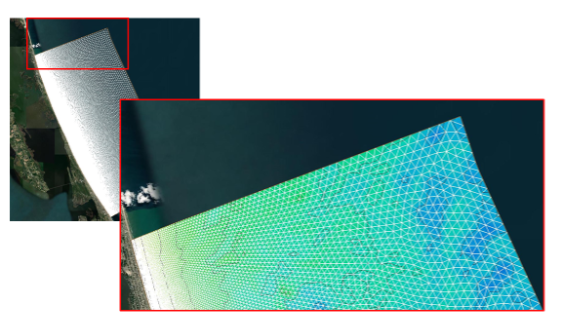
- Propagation of wave spectrum can be solved using regular (rectilinear or curvilinear) and unstructured (triangular) grids
- Unstructured meshing resolves coastal features in higher resolution at the relative lower cost of coarser offshore resolutions
- Implicit solvers for efficient time stepping and hybrid approach to parallelization for optimized model performance on high performance computing (HPC) architectures
- Coupled to atmospheric, circulation and ice models
- Compatible with the Earth System Modeling Framework (ESMF) software
Current release – version 6.07.1
Keywords
WAVEWATCH III, WW3, nearshore waves, wave transformation, wave modeling, wave propagation, wave energy, wind waves, phase-averaged, spectral, coastal, surface-water modeling system, SMS, implicit, unstructured mesh, complex shorelines
POC Email: CEERD-WW3@usace.army.mil
WW3 is a community wave model that is available to the general public. The WW3 source code is maintained with a version control repository on GitHub. A guide to accessing and installing the WW3 software can be found at https://github.com/erdc/WW3/blob/develop/model/README.md
The WW3 community website: https://github.com/erdc/WW3
Wiki: https://github.com/NOAA-EMC/WW3/wiki/About-WW3
WW3 User Guide: https://github.com/NOAA-EMC/WW3/wiki/WAVEWATCH-III-User-Guide
Current manual: https://github.com/NOAA-EMC/WW3/wiki/Manual
The first USACE Wave Training Workshop was held in April 2024 at the Field Research Facility in Duck, North Carolina. It provided a one-week comprehensive program for nearly 20 USACE District engineers, featuring lectures on wind-wave mechanics, spectral modeling, HPC, time-series analysis, oceanic observations, and statistical methods. Afternoons included hands-on tutorials using the USACE spectral wave model, WAVEWATCH III, led by a team of five instructors.
The second workshop was held in March 2025 at ERDC WERX in Vicksburg, Mississippi, and expanded to include participants from the U.S. Navy, NOAA, academia, and additional USACE Districts.
CHL plans to conduct this wave training annually under the HHC program.
Recent Journal Publications
- Oladejo, H. O., Bernstein, D. N., Cambazoglu, M. K., Nechaev, D., Abdolali, A., & Wiggert, J. D. (2024). Wind forcing, source term, and grid optimization for hurricane wave modelling in the Gulf of Mexico. Coastal Engineering, 104692. https://doi.org/10.1016/j.coastaleng.2024.104692
- Campos, R. M., Abdolali, A., Alves, J.-H., Masarik, M., Meixner, J., Mehra, A., Figurskey, D., Banihashemi, S., Sienkiewicz, J., and Lumpkin, R. (2024) Development and Validation of NOAA’s 20-year global wave ensemble reforecast. Weather and Forecasting, https://doi.org/10.1175/WAF-D-24-0043.1
- Alves, J.-H., Padilla-Hernandez, R., Spindler, D., Kolczynski, W., Rajan, B., Spindler, T., Abdolali, A., Campos, R., Banihashemi, S., and Meixner, J. (2024), Development of a Wave Model Component in the First Coupled Global Ensemble Forecast System at NOAA. Weather and Forecasting, https://doi.org/10.1175/WAF-D-24-0048.1
- Fujisaki-Manome, A., Hu, H., Wang, J., Westerink, J., Wirasaet, D., Ling, G., Choi, M., Moghimi, S., Myers, E., Abdolali, A., Dawson, C., & Janzen, C. (2024). Advanced sea ice modeling for short-term forecasting for Alaska’s coasts. Weather and Forecasting. https://doi.org/10.1175/WAF-D-23-0178.1
- Abdolali, A., Banihashemi, S., Alves, J. H., Roland, A., Hesser, T. J., Anderson Bryant, M., and McKee Smith, J. (2024) Great Lakes wave forecast system on high-resolution unstructured meshes, Geosci. Model Dev., 17, 1023–1039, https://doi.org/10.5194/gmd-17-1023-2024, 2024.
- Alves, J-H., H. Tolman, A. Roland, A. Abdolali, F. Ardhuin, G. Mann, A. Chawla, and J. Smith. 2022. NOAA’s Great Lakes Wave Prediction System: A Successful Framework for Accelerating the Transition of Innovations to Operations. Bulletin of the American Meteorological Society, in press.
- N. Monteiro, T. Oliveira, P. Silva, and A. Abdolali. 2022. Wind–wave characterization and modeling in the Azores Archipelago. Ocean Engineering 263: 112395.
- Abdolali. A., T.J. Hesser, M.A. Bryant, A. Roland, A. Khalid, J. Smith, C. Ferreira, A. Mehra, and M.D. Sikiric. 2022. Wave Attenuation by Vegetation: Model Implementation and Validation Study. Front. Built Environ. 8:891612.
- A. Abdolali, A. van der Westhuysen, Z. Ma, A. Mehra, A. Roland and S. Moghimi. 2021. Evaluating the Accuracy and Uncertainty of Atmospheric and Wave Model Hindcasts During Severe Events Using Model Ensembles. Ocean Dynamics 71: 217-235.
- Moghimi, S., A. Van der Westhuysen, A. Abdolali, E. Myers, S. Vinogradov, Z. Ma. F. Liu, A. Mehra, and N. Kurkowski. 2020. Development of an ESMF Based Flexible Coupling Application of ADCIRC and WAVEWATCH III for High Fidelity Coastal Inundation Studies. J. Mar. Sci. Eng. 8(5): 308.
- Abdolali A., A. Roland, A. Van der Westhuysen. J. Meixner, A. Chawla, T. Hesser, J.M. Smith, and M. Dutour Sikiric. 2020. Large-scale Hurricane Modeling Using Domain Decomposition Parallelization and Implicit Scheme Implemented in WAVEWATCH III Wave Model. Coastal Engineering 157: 103656.
The WW3 community has an ever-increasing suite of regression tests intended to verify and validate the numerical code integrity. WW3 developers are encouraged to check their implementations with the regression tests to ensure the code compilation, consistency of model output, and data reproducibility. These regression tests must be passed when new main or develop branches are created. More information about WW3 regression test, along with a list of the current regtests, is available at https://github.com/NOAA-EMC/WW3/wiki/Developer-Guide.
Details regarding WW3 official public releases, including hotfixes and updated capabilities, can be found at https://github.com/NOAA-EMC/WW3/releases.
Model Limitations: The implicit assumption of WW3 is that properties of medium (water depth and current) as well as the wave field itself vary on time and space scales that much larger than the variation scales of a single wave. Additionally, to resolve detailed near-field processes around coastal structures, such as wave reflection, diffraction, runup, and overtopping, a high-resolution, phase-resolving model such as FUNWAVE should be applied.