



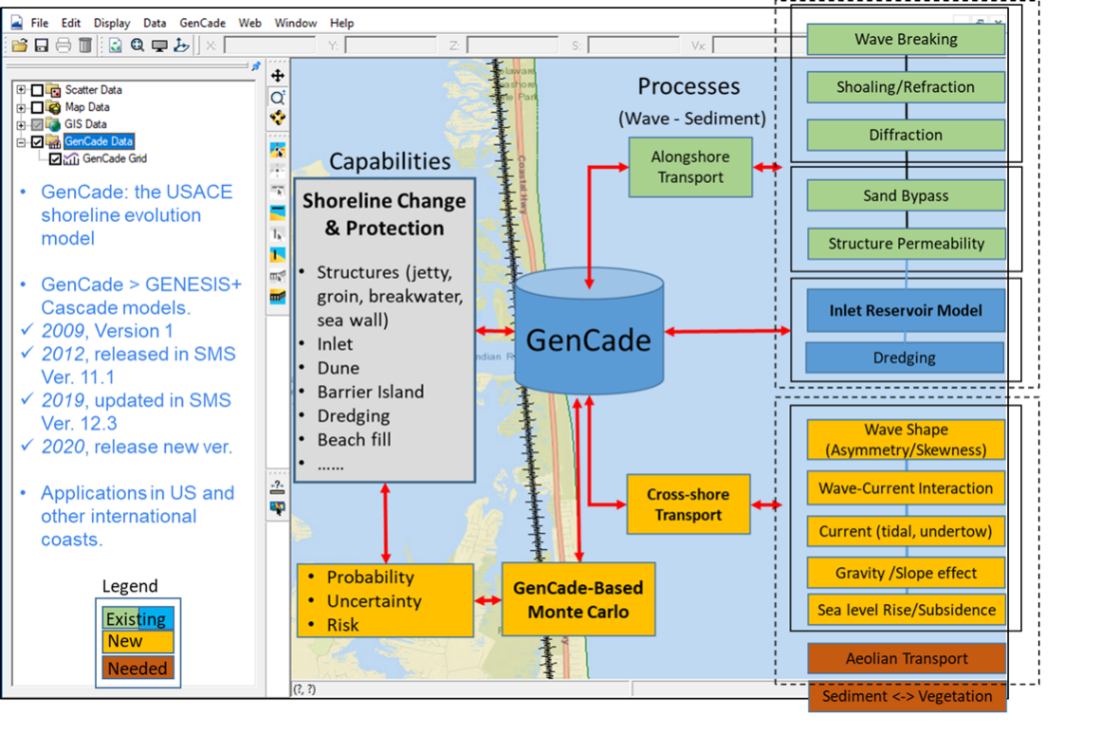
GenCade is a one-line shoreline simulation model that combines the capabilities of regional-scale, planning-level calculations of the Cascade model and project-scale, engineering design-level calculations of GENESIS. GenCade computes shoreline change, wave-induced longshore and cross-shore sand transport, and morphology change at inlets on a local to regional scale. It is operated within the Surface-water Modeling System (SMS) 11.1 interface and higher SMS. GenCade has been widely used in coastal engineering projects for erosion protection and coastal sediment management. Publications for GenCade, including user manual, technical reports, tutorial materials can be found on the GenCade community website, https://cirp.usace.army.mil/products/gencade.php.
Key features of GenCade:
- GenCade can simulate long-term and regional shoreline evolution driven by longshore and cross-shore sediment transport.
- Simulations of sediment transport and shoreline changes consider the effects of hard structures (e.g., groins, breakwaters, jetties, seawall, etc.) and soft structures (e.g., beach fills, sand nourishment, sand bypassing, dredging on tidal deltas).
- SMS GenCade interface supports development of georeferenced GenCade conceptual model by using GIS datasets of shorelines, hard structures, and soft structures.
- SMS GenCade interface provides various functions for pre- and post-processing of model development and result visualization.
- The model supports uniform and non-uniform 1-D GenCade grids.
- The model parameters such as depth of closure, K1, and K2 can be spatially varying.
- Internal wave transformation module for calculations of wave shoaling and breaking
- Arbitrary numbers of groins, detached breakwaters, beach fills & seawalls
- Combinations of structures & beach fills
- Bypassing & transmission of sand at groins & jetties
- Wave diffraction from multiple structures
- Multiple wave trains as wave input conditions
- Wave transmission through detached breakwaters
- Tombolo development inside detached breakwaters
- Sediment transport from breaking waves combined with other currents
- Accounts for pre-specified stable regional or local contours
- Algorithm for variable, time-dependent transmission coefficient
- The GenCade model includes a sub-model called the Inlet Reservoir Model (IRM) (https://cirp.usace.army.mil/products/irm.php to simulate inlet sand bypassing of longshore sediment transport through evolution of sand volume in inlet morphological elements.
- GenCade provides SBAS (https://cirp.usace.army.mil/products/sbas.php) with results of sediment transport fluxes for further sediment budget analysis.
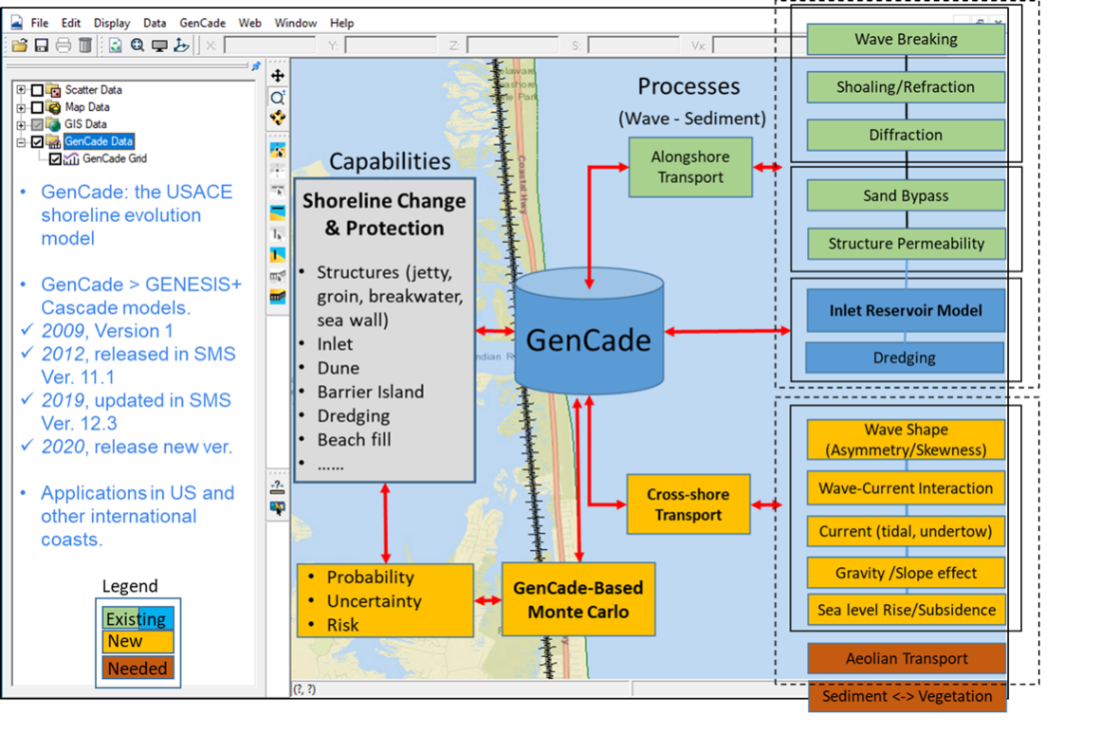
The current release version of GenCade is Version 1.1r8 (as of January 2023).
Keywords
Shoreline evolution modeling, longshore sediment transport, nearshore wave processes, cross-shore sediment transport, erosion protection, impact of coastal structures, beach fills, sand nourishment, coastal inlets, sea level rise and subsidence
Email to USACE POC – Yan Ding, Yan.Ding@usace.army.mil (No names to show up on website, but a link to send emails to model specific inboxes).
The GenCade modeling software is in general available for use by academic and government researchers at no charge for research and educational purposes. The modeling software is available for purchase for all others.
The GenCade source code is maintained within a version control repository on ERDC Internal Gitlab and is account access restricted. Email (link to GenCade model POC, Yan.Ding@usace.army.mil) for additional details about obtaining access to source code.
For USACE use, a Microsoft Window’s executable code is included with the SMS, which is also available from the GenCade community website at https://cirp.usace.army.mil/products/gencade.php. Email (link to GenCade model POC, Yan.Ding@usace.army.mil) for additional information on using GenCade.
A graphical user interface for GenCade is part of the Surface-water Modeling System (SMS). For USACE users, SMS is available from the ACE-IT App Portal.
The GenCade Community Website: https://cirp.usace.army.mil/products/gencade.php has information of software update, training materials (ppts, videos, examples, etc.-), and publications.
A GenCade Wiki page is also available at https://cirpwiki.info/wiki/GenCade, providing online User’s Guides, the model theory, and validation cases.
Additional tutorials for GenCade, particularly using the Surface-water Modeling System (SMS) interface, are also available from https://www.aquaveo.com/software/sms-gencade
Place holder for link to USACE developed training materials for GenCade, e.g., https://cirp.usace.army.mil/techtransfer/workshops/SAM-2022/SAM-Workshop.php.
Recent USACE Reports
- Ding, Y., Styles, R., Kim, S-C, Permenter, R., Frey, A. (2020). Cross-Shore Transport Feature for GenCade, ERDC/CHL CHETN-IV-123, April 2020.
- Kim, S. C., Styles, R., Rosati, J., Y. Ding, and R. Permenter (2020). A Comparison of GenCade, Pelnard-Considere, and LITPACK, ERDC/CHL CHETN-IV-124, April 2020
- Ding, Y., S. C. Kim, R. Permenter, R. Styles, and Gebert, J. A. (2021). Simulations of Shoreline Changes along the Delaware Coast, ERDC/CHL TR-21-1, Vicksburg, MS: US Army Engineer Research and Development Center, http://dx.doi.org/10.21079/11681/39559, January 2021
- Ding, Y., Hampson, R., Friebel, H., Watson, K., and Kim, S.-K. (2022). Calibration and Validation of Shoreline Evolution Model on the Erosion Hot Spot near Absecon Inlet, Atlantic City, New Jersey, ERDC-CHL LR-23-1.
- Frey, A. E., Connell, K. J., Hanson, H., Larson, M., Thomas, R. C., Munger, S., Zundel, A., (2012) GenCade version 1 Model theory and user’s guide. US Army, Engineer Research and Development Center, ERDC/CHL TR-12-25, 169 pp.
Recent Journal Publications
- Ding, Y., Styles, R., Kim, S.-C., Permenter, R.L., and Frey A.E. (2021). Cross-shore sediment transport for modeling long-term shoreline evolution, J. Waterway, Port, Coastal, Ocean Eng., 2021, 147(4): 04021014, 25pp., DOI: 10.1061/(ASCE)WW.1943-5460.0000644
- Whitley, A. E., Figlus, J., Valsamidis, A., and Reeve, D. E. (2021). One-line modeling of mega-nourishment evolution. Journal of Coastal Research, 37(6), 1224–1234. https://doi.org/10.2112/JCOASTRES-D-20-00157.1
The GenCade developers have developed a suite of test cases to verify the capabilities of shoreline modeling along natural shoreline and structures-protected shorelines (https://cirpwiki.info/wiki/GenCade_Val:Benchmark_Cases). The GenCade user community have also developed GenCade application models for feasibility study of erosion protection projects, which were validated by using site-specific coastal survey data. Several datasets of test cases are available via the GenCade user community site at https://cirpwiki.info/wiki/GenCade#Examples. Those test cases are run any time when a change is made to the model code and the new code must pass all tests before a new executable GenCade code is released.
This space is intended to be used to describe code modifications since the last release, including bug fixes and possible impacts of those bugs to the code results.