



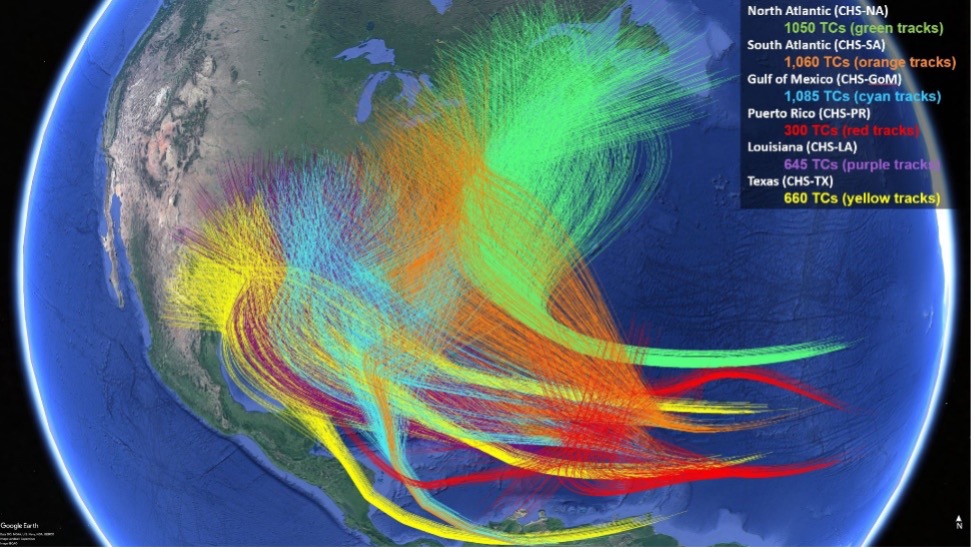
The Coastal Hazards System (CHS) (https://chs.erdc.dren.mil) is a national-scale, multi-agency initiative for quantifying coastal hazards from hurricanes and extratropical storms along U.S. coastlines and other strategic locations critical to national security. The CHS is a central USACE and federal resource of consistent high-fidelity, high-resolution coastal hazard data, covering frequent to extreme storm events. Using its cutting-edge CHS-Probabilistic Framework (CHS-PF), CHS encompasses a wide range of coastal hazards, including storm surge, waves, wind, rainfall, compound coastal-inland flooding, seiche, extreme tides, mean sea level fluctuation (SLF), and storm climatology changes. CHS is an industry-standard and easily accessible web-based environment for development, storage, and rapid access to probabilistic coasta hazard results and hydrodynamic modeling simulations of coastal storms. A user-friendly interface provides easy access, mining, plotting, and downloading of high-fidelity probabilistic and numerical modeling results for historical and synthetic coastal storms that could impact U.S. coastlines. CHS provides direct support to federal, state, local, and academic partners throughout a diverse array of activities, including:
- Planning and feasibility studies
- Coastal Storm Risk Management (CSRM)
- Flood Risk Management (FRM)
- Navigation
- Stochastic engineering design
- Reliability analysis of coastal structures
- Storm response prediction for emergency management and operations
- Coastal resiliency
Currently, the CHS webtool offers probabilistic hazard and hydrodynamic modeling results at more than 100,000 point locations covering U.S. coastlines from Texas to Maine, including Puerto Rico and the U.S. Virgin Islands. These data have been used in more than 30 coastal studies conducted by the USACE and other government partners, saving a projected $280 billion in prevented damages and economic losses.
Keywords
Coastal Hazards System, CHL, StormSim, tropical cyclones, extratropical cyclones, coastal storms, hurricanes, Probabilistic Coastal Hazard Analysis, Joint Probability Method, rainfall, storm surge, waves, water level, annual exceedance frequency, annual exceedance probability, hydrodynamic modeling
POC Email:
Madison Yawn: CoastalHazardsGroup@erdc.dren.mil
- The CHS website and webtool are publicly available for users interested in accessing the data from regional coastal hazards studies conducted by the U.S. Army Corps of Engineers and the Federal Emergency Management Agency. The webtool is a graphical user interface (GUI) where users can explore and download available data through an interactive map. For access to download data, users are asked to create an account by supplying contact information on the Register tab of the website.
- The CHS source code supporting the website and webtool GUI is maintained within a version control repository on GitHub and is account access restricted. Email (CoastalHazardsGroup@erdc.dren.mil) for additional details about obtaining access to source code.
- User information for navigation through CHS, filename conventions, and data formats is documented in the CHS User Guide, which is accessible under the website’s Help tab: https://chs.erdc.dren.mil/Content/documents/CHSUserGuide.pdf.
- The CHS website offers a Quick Start Guide to quickly illustrate how users can navigate through the webtool to find data available for a location of interest. This document is accessible through the Help tab on the CHS website: https://chs.erdc.dren.mil/Content/documents/CHSQuickGuide.pdf.
- A Frequently Asked Questions (FAQ) document is also available through the Help tab, where users may find helpful information from common questions related to navigation through the webtool, available data, and more: https://chs.erdc.dren.mil/Content/documents/CHSFAQ.pdf
- The CHS Library offers a variety of documentation and additional data for the CHS coastal studies, including metadata files, data status, statistics, and reports. Find these resources using the Library Tab on the CHS website.
Recent USACE Reports:
- Nadal‐Caraballo, N. C., J. A. Melby, V. M. Gonzalez, and A. T. Cox. 2015. North Atlantic Coast Comprehensive Study–Coastal Storm Hazards from Virginia to Maine. ERDC/CHL TR-15-5. Vicksburg, MS: US Army Engineer Research and Development Center. https://apps.dtic.mil/sti/citations/ADA621343
- Nadal-Caraballo, N. C., M. C. Yawn, L. A. Aucoin, M. L. Carr, A. A. Taflanidis, A. P. Kyprioti, J. A. Melby, E. Ramos-Santiago, V. M. Gonzalez, T. C. Massey, Z. Cobell, and A. T. Cox. 2022. Coastal Hazards System–Louisiana (CHS-LA). ERDC/CHL TR 22-16. Vicksburg, MS: US Army Engineer Research and Development Center. https://apps.dtic.mil/sti/citations/AD1178936
- Nadal-Caraballo, N. C., M. C. Yawn, L. A. Aucoin, M. L. Carr, J. M. Melby, E. Ramos-Santiago, F. A. Garcia-Moreno, V. M. Gonzalez, M. B. Owensby, A. A. Taflanidis, A. P. Kyprioti, A. T. Cox, and J. Gonzalez-Lopez. 2022. Coastal Hazards System–Puerto Rico and US Virgin Islands (CHS-PR). ERDC/CHL TR 22-23. Vicksburg, MS: US Army Engineer Research and Development Center. http://dx.doi.org/10.21079/11681/46200
- Yawn, M.C., Nadal-Caraballo, N.C., Aucoin, L.A., Carr, M.L., Melby, J.A., Ramos-Santiago, E., Garcia-Moreno, F., Gonzalez, V.M., Massey, T.C., Owensby, M.B., Taflanidis, A.A., Kyprioti, A.P., Cox, A.T. (2024). Coastal Hazards System–South Atlantic (CHS-SA). ERDC/CHL TR-24-2. Vicksburg, MS: U.S. Army Engineer Research and Development Center. http://dx.doi.org/10.21079/11681/48295.
- Yawn, M.C., Nadal-Caraballo, N.C., Aucoin, L.A., Carr, M.L., Melby, J.A., Ramos-Santiago, E., Garcia-Moreno, F., Gonzalez, V.M., Massey, T.C., Owensby, M.B., Taflanidis, A.A., Kyprioti, A.P., Cox, A.T. (2024). Coastal Hazards System–Gulf of Mexico (CHS-GoM). ERDC/CHL TR-24-3. Vicksburg, MS: U.S. Army Engineer Research and Development Center. http://dx.doi.org/10.21079/11681/48296, in press.
Recent Journal Articles:
- Zhang, J., A. A. Taflanidis, N. C. Nadal-Caraballo, J. A. Melby, and F. Diop. 2018. “Advances in Surrogate Modeling for Storm Surge Prediction: Storm Selection and Addressing Characteristics Related to Climate Change.” Natural Hazards 94:1225–1253. https://doi.org/10.1007/s11069-018-3470-1
- Jia, G., A. A. Taflanidis, N. C. Nadal-Caraballo, J. A. Melby, A. B. Kennedy, and J.M. Smith. 2016. “Surrogate Modeling for Peak or Time-Dependent Storm Surge Prediction over an Extended Coastal Region Using an Existing Database of Synthetic Storms.” Natural Hazards 81:909–938. https://doi.org/10.1007/s11069-015-2111-1
- Nadal-Caraballo, N. C., M. O. Campbell, V. M. Gonzalez, M. J. Torres, J. A. Melby, and A. A. Taflanidis. 2020. “Coastal Hazards System: A Probabilistic Coastal Hazard Analysis Framework. Global Coastal Issues of 2020.” Journal of Coastal Research Special Issue 95:1211–1216. https://doi.org/10.2112/SI95-235.1
- Torres, M.J., N.C. Nadal-Caraballo, E. Ramos-Santiago, M. O. Campbell, V. M. Gonzalez, J. A. Melby, and A. A. Taflanidis. 2020. StormSim CHRPS: Coastal Hazards Rapid Prediction System. Proceedings from the International Coastal Symposium (ICS) 2020. Journal of Coastal Research 95: 1320-1325. https://doi.org/10.2112/SI95-254.1
- Kyprioti, A., A. A. Taflanidis, N. C. Nadal-Caraballo, M. C. Yawn, and L. A. Aucoin. 2022. Integration of Node Classification in Storm Surge Surrogate Modeling. Journal of Marine Science and Engineering 10:551. https://doi.org/10.3390/jmse10040551
- Kyprioti, A., A. A. Taflanidis, N. C. Nadal-Caraballo, and M. O. Campbell. 2021. Incorporation of sea level rise in storm surge surrogate modeling. Natural Hazards 105:531-563. https://doi.org/10.1007/s11069-020-04322-z
- Kyprioti, A., A. A. Taflanidis, N. C. Nadal-Caraballo, and M. O. Campbell. 2021. Storm hazard analysis over extended geospatial grids utilizing surrogate models. Journal of Coastal Engineering 168. https://doi.org/10.1016/j.coastaleng.2021.103855
- Kyprioti, A. P., Irwin, C., Taflanidis, A. A., Nadal-Caraballo, N. C., Yawn, M. C., & Aucoin, L. A. 2023. Spatio-temporal storm surge emulation using Gaussian Process techniques. Coastal Engineering, 180, 104231. https://doi.org/10.1016/j.coastaleng.2022.104231
- Jung, W., Taflanidis, A.A., Nadal-Caraballo, N.C., Yawn, M.C. & Aucoin, L.A. 2024. Regional storm surge hazard quantification using Gaussian process metamodeling techniques. Natural Hazards, 120(1), 755-783. https://doi.org/10.1007/s11069-023-06195-4
As a web-based platform designed to share coastal hazards data publicly, the primary component of the CHS Verification and Validation is a test environment that mimics the public CHS website and GUI. This environment is critical for testing updates to achieve successful implementation of new functionalities and data for CHS. This test environment is access-limited and allows for in-depth testing of functionality and data updates prior to releasing them to the public. Users are encouraged to report any functionality limitations they encounter or suggestions for future capabilities using the Contact Form found in the Help tab of the website.
- Graphic showing the model domain and/or results
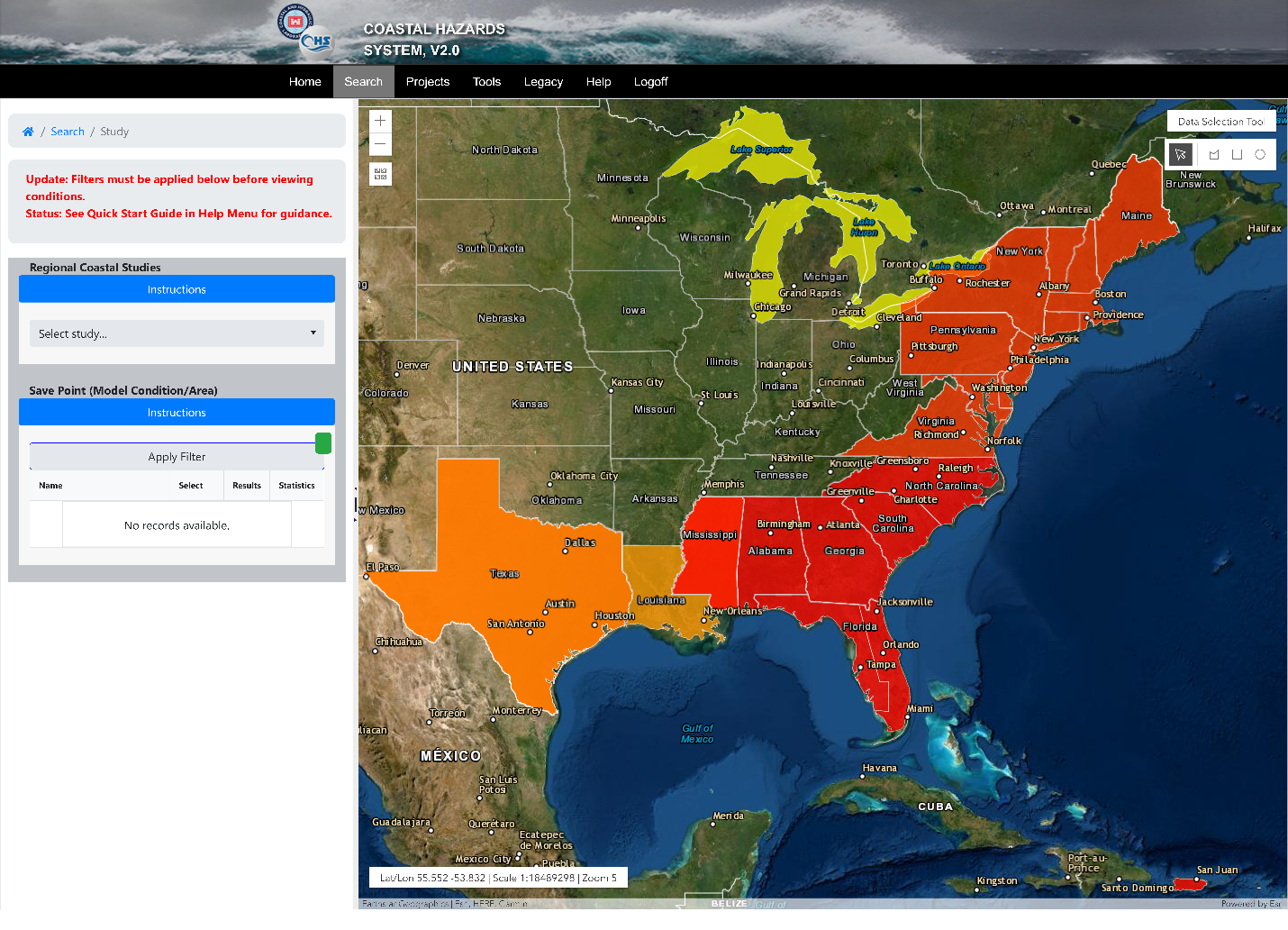
All revisions made to the CHS website and webtool functionality are documented on the Updates page, which can be accessed from the website’s Help tab. Updates are also posted for any additions or corrections made to available data. Posted updates include a date of occurrence and a complete description of all changes or additions made to the system.