



Adaptive Hydraulics (AdH) is a modern, multi-dimensional modeling system for saturated and unsaturated groundwater, overland flow, three-dimensional Navier-Stokes flow, and two-dimensional or three-dimensional shallow water flow. Developed by the Coastal and Hydraulics Laboratory at the Engineer Research and Development Center in Vicksburg, MS, the 2-dimensional (2D) shallow water module of AdH was released to the public in September 2007.
AdH uses an unstructured mesh that has the ability to capture wetting/drying fronts such as tide conditions and flood wave propagation. AdH includes linkages to SEDLIB, a sediment model library that computes mixed grain size sediment transport for cohesive and noncohesive sediment along with capturing the bed layering mechanism that occurs during various flow events. AdH is useful for evaluating engineering design and impacts to navigation, flooding, salinity transport, and sedimentation, including Engineering with Nature (EWN), natural and nature-based features.
AdH can be utilized on PC and high performance computers (HPC).
A range of modeling applications can be addressed with AdH, including:
- Design of approach channel improvements
- Guardwall porting design
- Design of a fish passage structure through an existing spillway
- Velocity field calculations during different stages of construction
- Overall effects of sedimentation due to the proposed work.
- Evaluating the effects of multiple projects constructed within a river reach to support objectives for both navigation and ecosystem restoration.
- Salinity intrusion analysis in conjunction with system changes.
- Impacts of navigation channel design changes on ship passage by supplying hydrodynamic results to the Ship Simulator.
- Effects of vessel traffic on hydrodynamics, salinity, and sedimentation with the use of simulating vessel movement in the model.
- Flood inundation by use of dynamic and continuous wetting/drying fronts.
Key features of AdH:
- Unstructured mesh allows for high localized resolution where solution gradients maybe large, and lower grid resolution where solution gradients are small, as well as dynamic mesh adaption to increase resolution where and when necessary
- Continuous wetting/drying fronts
- Riverine, Wind, atmospheric pressure, flows, tides,
- Salinity and temperature transport modeling, as well as constituent (i.e. contaminant) transport
- Friction library to include Mannings, equivalent roughness height, and vegetative roughness
- Supercritical flow internal to the model domain and as applied boundary conditions
Vessel movement library to include moving pressure fields and their impact on the surrounding flow conditions
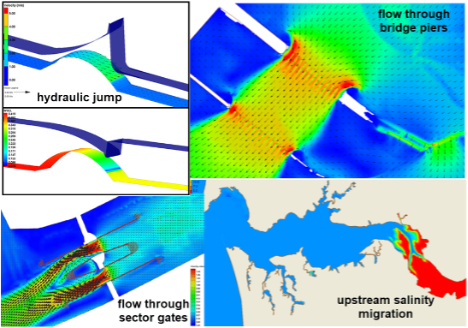
Example ADCIRC meshes showing resolution details and bathymetry.
The current release version of AdH is Version 4.7 (as of March 2023).
AdH website: https://www.erdc.usace.army.mil/Locations/CHL/AdH/
Keywords:
AdH, Adaptive Hydraulics, hydrodynamic, circulation, sediment, transport, tides, floods, inundation, 2D, 3D, baroclinic, barotropic, hydrostatic, supercritical
Contact:
ADH@usace.army.mil
The AdH modeling software is available for use by all parties at no charge.
A Microsoft Window's executable is available for download from the AdH website https://www.erdc.usace.army.mil/Locations/CHL/AdH/. This executable, along with a graphical user interface for AdH, is included with the Surfacewater Modeling System (SMS). For USACE users, the AdH Windows executable and SMS are available from the ACE-IT software portal. SMS is also available for download from https://www.aquaveo.com/software/sms-surface-water-modeling-system-introduction.
A graphical user interface for AdH is part of the Surfacewater Modeling System (SMS). For USACE users, SMS is available from the ACE-IT App Portal. SMS is also available for download from https://www.aquaveo.com/software/sms-surface-water-modeling-system-introduction.
AdH executables for Windows PC
Version 4.7.1, 2D Shallow Water (serial and multiprocessor, 64 bit)
The single link will take you to the ERDC Knowledge Core record to download a zipped file with the version 4.7.1 Pre-AdH and AdH executables and a mpi library installation file. Also included is a serial compile of the version 4.7.1 code if you are unable to install the mpi library on your PC.
Adaptive Hydraulics Version 4.7.1
Version 4.7, 2D Shallow Water (serial and multiprocessor, 64 bit)
The single link will take you to the ERDC Knowledge Core record to download a zipped file with the version 4.7 Pre-AdH and AdH executables along with the Hotstart File Generator executable.
Adaptive Hydraulics Version 4.7
Version 4.6, 2D Shallow Water - 64 bit
Separate links for serial and multiprocessor Pre_AdH and AdH executables (The files downloaded from the digital library will need to be renamed to the corresponding executable name.)
64 bit Windows PC Pre_Adh V4.6
64 bit Multiprocessor Windows PC Pre_AdH V4.6
64 bit Multiprocessor Windows PC AdH V4.6
Additional Executables
64 bit Windows Hotstart File Generator
Microsoft-MPI (To run multiple processors on a Windows PC, Microsoft MPI must be installed on the machine.)
AdH Utilities Application (Used to process AdH solution data)
- The AdH website: https://www.erdc.usace.army.mil/Locations/CHL/AdH/ has information on how to use AdH including access to user guides and model support documents. The website also includes verification and validation cases.
- Additional tutorials for AdH, particularly using the Surfacewater Modeling System (SMS) interface, are available from https://www.aquaveo.com/software/sms-learning.
Recent USACE Reports
- Savant G, Berger RC, Brown GL, Trahan CJ. Theory, Formulation, and Implementation of the Cartesian and Spherical Coordinate Two-Dimensional Depth-Averaged Module of the Adaptive Hydraulics (AdH) Finite Element Numerical Code. Vicksburg, MS: US Army Engineer Research and Development Center, Coastal and Hydraulics Laboratory and Information Technology Laboratory; 2020. https://doi.org/10.21079/11681/36993.
- Pevey KC, Savant G, Moritz HR, Childs EO. Lower Columbia River Adaptive Hydraulics (Adh) Model : Development, Water Surface Elevation Validation, and Sea Level Rise Analysis. Vicksburg, MS: U.S. Army Engineer Research and Development Center, Coastal and Hydraulics Laboratory; 2020. https://doi.org/10.21079/11681/35853.
- Brown GL, Pevey KC, Pevey KC. Hydrodynamic, Salinity, and Morphological Modeling Study of a Sediment Diversion : An Application of the Adaptive Hydraulics Model/Sedlib Sediment Transport Library. Vicksburg, MS: U.S. Army Engineer Research and Development Center, Coastal and Hydraulics Laboratory; 2019.
- Gaines RA, Sanborn S, McAnally WH, Wallen CM. Mississippi River Adaptive Hydraulics Model Development and Evaluation : Commerce to New Madrid, Missouri, Reach. Vicksburg, MS: US Army Corps of Engineers, Mississippi Division; 2021.
- McAlpin JN, Ross CG, Ross CG, McKnight CJ. Houston Ship Channel and Vicinity Three-Dimensional Adaptive Hydraulics (AdH) Numerical Model Calibration/Validation Report. Vicksburg, MS: U.S. Army Engineer Research and Development Center, Coastal and Hydraulics Laboratory; 2019. https://doi.org/10.21079/11681/33063.
- Savant G, Trahan CJ, Trahan CJ, McAlpin TO. Formulation, Implementation and Testing of the Diffusive Wave (Dw) Module of Adaptive Hydraulics (AdH). Vicksburg, MS: U.S. Army Engineer Research and Development Center Coastal and Hydraulics Laboratory; 2018. https://doi.org/10.21079/11681/29351.
Recent Journal Publications
- Gaurav Savant, Corey J. Trahan, Lucas Pettey, Tate O. McAlpin, Gary L. Bell, Charles J. McKnight. Urban and overland flow modeling with dynamic adaptive mesh and implicit diffusive wave equation solver. “Journal of Hydrology”, Volume 573, 2019, Pages 13-30, ISSN 0022-1694, https://doi.org/10.1016/j.jhydrol.2019.03.061.
- Timothy A. Stephens, Gaurav Savant, Stephen C. Sanborn, Christopher M. Wallen. Monolithic Multiphysics Simulation of Compound Flooding. “Journal of Hydraulic Engineering”, Volume 148, Issue 9, September 2022. https://ascelibrary.org/doi/full/10.1061/%28ASCE%29HY.1943-7900.0002000
- R.C. Berger and Jens Kiesel. Conceptual Model of Salinity Intrusion by Tidal Trapping, “Journal of Hydraulic Engineering”, Volume 145, Issue 10, October 2019. https://ascelibrary.org/doi/full/10.1061/%28ASCE%29HY.1943-7900.0001627
- Jennifer N. Tate, Gaurav Savant, and Darla C. McVan. Rapid Response Numerical Modeling of the 2010 Pakistan Flooding, “Leadership and Management in Engineering, Volume 12, Issue 4, October 2012. https://ascelibrary.org/doi/abs/10.1061/%28ASCE%29LM.1943-5630.0000197
- Gaurav Savant and R.C. Berger. Adaptive Time Stepping-Operator Splitting Strategy to Couple Implicit Numerical Hydrodynamic and Water Quality Codes, “Journal of Environmental Engineering”, Volume 138, Issue 9, September 2012. https://ascelibrary.org/doi/abs/10.1061/%28ASCE%29EE.1943-7870.0000547
User Guides
- Coastal and Hydraulics Laboratory (U.S.). 2024. "Adaptive Hydraulics 2D Shallow Water (AdH-SW2D) User's Manual (Version 4.7.1): Guidelines for Solving 2D Shallow Water Problems with the Adaptive Hydraulics Modeling System." ERDC-CHL SR-24-4. Vicksburg, MS. https://erdc-library.erdc.dren.mil/server/api/core/bitstreams/89ce62e9-8e76-471f-8dea-e46f7a034569/content
- Coastal and Hydraulics Laboratory (U.S.). 2024. "Adaptive Hydraulics (AdH) Version 4.7.1 Sediment Transport User's Manual: a 2D Modeling System Developed by the Coastal and Hydraulics Laboratory." ERDC-CHL SR-24-6. Vicksburg, MS. https://erdc-library.erdc.dren.mil/server/api/core/bitstreams/2a59ab66-37f5-423e-8998-231dda832186/content
The AdH developers’ maintain a suite of test cases to ensure model consistency among releases as well as ensure model verification and validation. Several of these examples are included on the AdH website: https://www.erdc.usace.army.mil/Locations/CHL/AdH/ with documentation, recent results and access to the model input files.
Information on modifications from prior released versions of AdH can be found on the AdH website: https://www.erdc.usace.army.mil/Locations/CHL/AdH/ in the “Downloads” section and is labeled “AdH Important Changes.”