


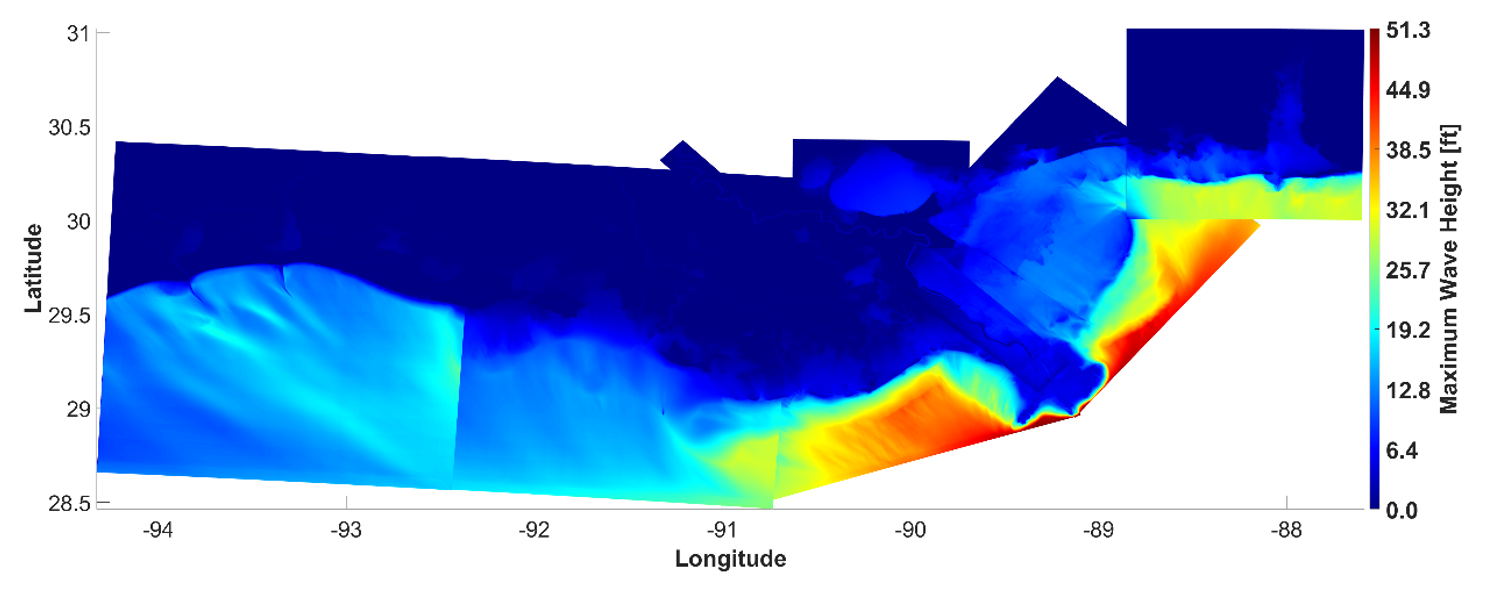
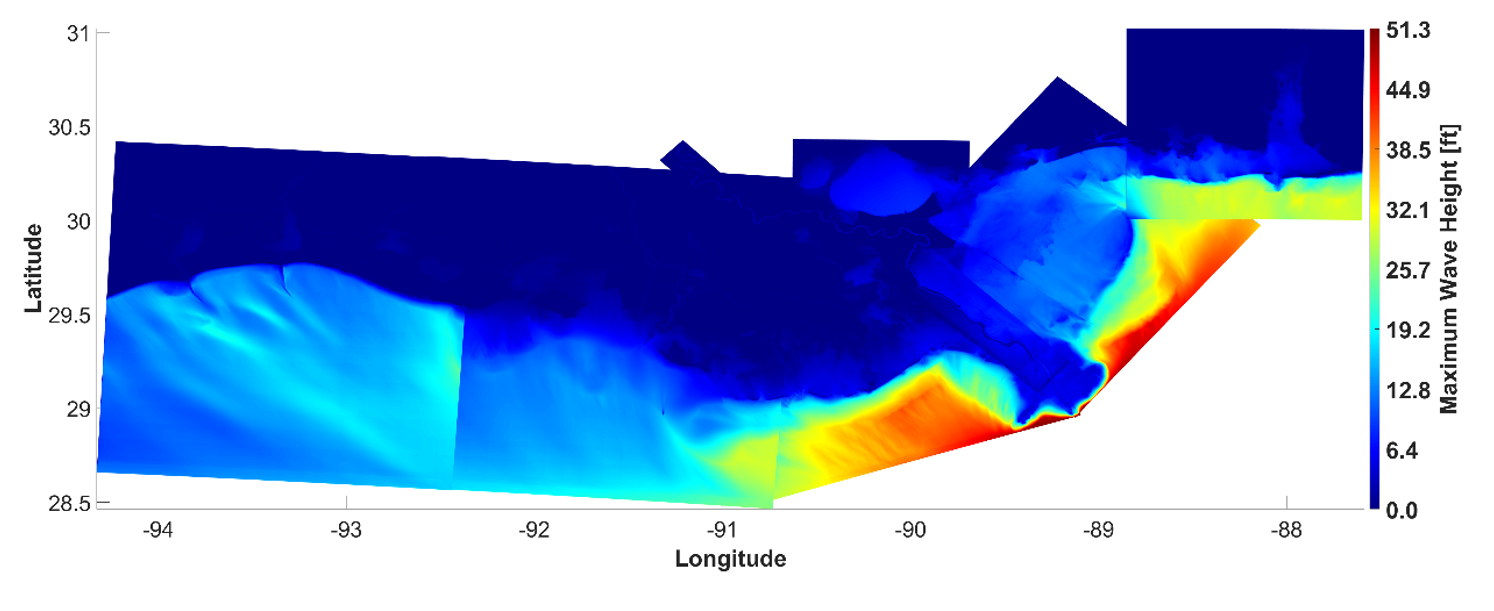
The STeady-state spectral WAVE model (STWAVE) is a numerical model for simulating nearshore wind-wave growth, propagation, and transformation along open coasts, bays, estuarine systems, and large lakes and reservoirs. STWAVE is a finite-difference, phase-averaged spectral wave model based on the wave action balance equation. STWAVE can either be run in serial (single processors) or parallel-in-space using domain decomposition (multiple processors). Common applications include the transformation of offshore wave information (wave height, period, direction, and spectral shape) obtained from wave buoys or global- or regional-scale wave hindcasts or forecasts to the nearshore coastal area and the estimation of wind-waves in enclosed water bodies.
Key features of STWAVE:
- Simple and robust wave modeling technology
- Cartesian grid
- Simulates depth- and current-induced wave refraction and shoaling; depth- and steepness-induced wave breaking; wind-wave growth; wave-wave interaction and whitecapping; and wave dissipation due to bottom friction
- Two modes available based on project requirements: half-plane mode (wave energy propagation from the offshore to the nearshore only) or full-plane mode (wave generation on full 360-deg plane)
- Allows for the simulation of completely independent conditions (e.g., combinations of different wind speeds and directions along a fetch) as well as time sequences by performing computations throughout an event as needed (e.g., a storm event by performing a computation every 30-minutes)
- Allows for parent-child grid nesting, which reduces computational time and increases accuracy in the vicinity of the project location
- May be coupled to ADCIRC (Advanced CIRCulation model for shelves, coasts, and estuaries) and AdH (Adaptive Hydraulics) using the ERDC Coastal Storm Modeling (CSTORM) coupler for estimating wave-driven currents and wave-induced setup and setdown
- Compatible with the Earth System Modeling Framework (ESMF) software
Current release – version 6.0
Keywords
STWAVE, nearshore waves, wave transformation, wave modeling, wave propagation, wave energy, steady-state, wind waves, phase-averaged, spectral, coastal, surface-water modeling system, SMS
POC Email: ceerd-stwave@usace.army.mil
The STWAVE modeling software is available to both government and non-government organizations, including academia and the private sector, at no cost. In addition, the STWAVE executable is also maintained on several Department of Defense (DoD) High Performance Computing (HPC) systems for USACE use. Please email ceerd-stwave@usace.army.mil for more information about the STWAVE executable.
The STWAVE source code is maintained within a version control repository on Git and is account access restricted. Presently, the STWAVE code is closed source and may not be altered or distributed. Requests for the STWAVE source code may be directed to ceerd-stwave@usace.army.mil and require signing a non-disclosure/non-distribution statement.
Both the STWAVE modeling software executable and graphical user interface for model setup, execution, and visualization is available within the Surface-water Modeling System (SMS). For USACE users, the full version of SMS is available for download from the ACE-IT App Portal. Other parties interested in acquiring SMS may visit https://www.aquaveo.com/software/sms-surface-water-modeling-system-introduction for more information.
Current manual: https://erdc-library.erdc.dren.mil/jspui/handle/11681/1850 (update in progress)
Details of grid nesting: https://apps.dtic.mil/sti/citations/ADA459646
STWAVE tutorials using using SMS are available from https://www.aquaveo.com/software/sms-learning.
- Bak, A.S., K.L. Brodie, T.J. Hesser, and J.M. Smith. 2019. Applying dynamically updated nearshore bathymetry estimates to operational nearshore wave modeling. Coastal Engineering, 145: 53-64.
- Bryant, M.A. and R.E. Jensen. 2017. Application of the nearshore wave model STWAVE to the North Atlantic Coast Comprehensive Study. J. Waterway, Port, Coastal, Ocean Eng., 143(5): 04017026.
- Smith, J.M., M.A. Bryant, and T.V. Wamsley. 2016. Wetland buffers: numerical modeling of wave dissipation by vegetation. Earth Surf. Process. Landforms, 41: 847-854.
- Fonseca, R.B, M. Gonçalves, and C. Guedes Soares. 2017. Comparing the performance of spectral wave models for coastal areas. J. Coast Res., 33(2): 331-346.
- Gonçalves, M., E. Rusu, and C. Guedas Soares. 2015. Evaluation of two spectral wave models in coastal areas. J. Coast Res., 31(2): 326-339.
- Bender, C., J.M. Smith, A. Kennedy, and R. Jensen. 2013. STWAVE simulation of Hurricane Ike: Model results and comparison to data. Coastal Engineering, 73: 58-70.
Building a suite of test cases to verify and validate the numerical code integrity and ensure solutions are consistent across release is ongoing. These test cases will encompass a broad range of STWAVE model setups and will also serve as instructional examples of different STWAVE model parameter settings. Please email ceerd-stwave@usace.army.mil if you are interested in obtaining or adding you project to the STWAVE test cases.
This space is intended to be used to describe code modifications since the last release, including bug fixes and possible impacts of those bugs to the code results.
Model Limitations: STWAVE is formulated as a steady-state model, which assumes that the winds have remained steady sufficiently long for the waves to attain fetch-limited or fully-developed conditions. Additionally, STWAVE assumes that relative phases of the spectral components are random, and phase information is not tracked (i.e, phase-averaged). To resolve detailed near-field processes around coastal structures, such as wave reflection, diffraction, runup, and overtopping, a high-resolution, phase-resolving model such as FUNWAVE should be applied.
Inputs files developed for previous versions of STWAVE are not compatible with STWAVE 6.0+.