



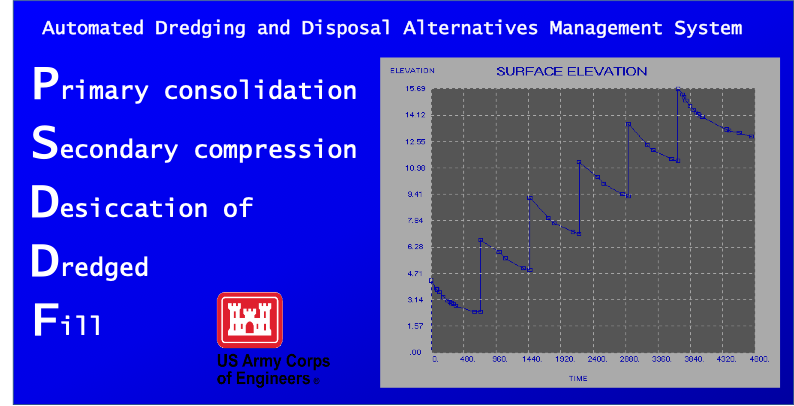
PSDDF simulates the primary consolidation, secondary compression, and desiccation processes in fine-grained soils (e.g. dredged fill) using the one-dimensional finite strain theory of consolidation (Gibson, et al. 1967), the secondary compression theory proposed by Mesri and Godlewski (1977), and an empirical desiccation model (Cargill 1985). PSDDF calculates the total settlement of a dredged fill layer based on the consolidation characteristics of the soils above and/or below the layer, the consolidation characteristics of the dredged fill, local climatological data, and surface water management techniques within the containment area. This settlement is then accumulated for each compressible layer within the area and a cumulative settlement for all dredged fill and compressible foundation layers is calculated. PSDDF has been used to design confined disposal facilities for dredged material, to determine dredged material mound capacity at open water placement sites, and more recently used to determine the amount of dredged material that should be placed to construct or rehabilitate degrading wetlands to achieve long-term target elevations for optimal marsh function.
Key features of PSDDF:
- Incorporates settlement caused by secondary compression which may contribute significantly to long-term settlement.
- Allows modeling of underwater disposal or filling which is useful for estimation of optimal filling schedules for contained aquatic disposal, capping underwater contaminated sediments, or creation of port facilities.
- Allows consideration of over- or under-consolidated foundation material.
- Graphical features allow void ratio-effective stress and void ratio-permeability relationships to be viewed to verify the magnitude and trend of the data prior to execution.
- A database of material properties and site characteristics for twenty-seven dredged materials throughout the country and three less compressible soils is incorporated and allows the user to select void ratio-effective stress and void ratio-permeability relationships. The database also includes rainfall, evaporation data and desiccation parameters for twenty placement areas around the United States.
The current release version of PSDDF is Version 1.0.
Keywords:
PSDDF, dredged material, consolidation, secondary compression, desiccation, finite strain consolidation, confined disposal, beneficial use, model
Email to USACE POC – Paul.R.Schroeder@usace.army.mil
The PSDDF modeling software is available at no charge. A self-extracting executable file for PSDDF Version 2.1 can be downloaded from https://dots.el.erdc.dren.mil/products.cfm?Topic=model&Type=drgmat. Note this version must be operated in a DOS-based operating environment. Until this version can be updated, a DOS emulator such as DOSBox or DOSBox-X must be utilized to operate PSDDF on 64-bit operating systems. DOSBox can be accessed at https://www.dosbox.com/, and DOSBox-X can found at https://dosbox-x.com/. Alternatively, PSDDF can be run on older Windows systems that accommodate 16-bit computing such as Windows XP or even older operating systems.
Email (Paul.R.Schroeder@usace.army.mil) for additional information on access or use of PSDDF.
Program documentation and User’s Guide can be accessed at https://dots.el.erdc.dren.mil/elmodels/pdf/psddf/psddf.pdf.
Two companion papers by Stark, Choi and Schroeder (2005a and 2005b) describe the model function and the input parameters: DOI: 10.1061/~ASCE!0733-950X~2005!131:2~43!, and DOI: 10.1061/~ASCE!0733-950X~2005!131:2~52!, accessible at https://ascelibrary.org/doi/full/10.1061/%28ASCE%290733-950X%282005%29131%3A2%2843%29 and https://ascelibrary.org/doi/10.1061/%28ASCE%290733-950X%282005%29131%3A2%2852%29.
The major input required by PSDDF is the void-ratio effective stress and void ratio-permeability relationships obtained from laboratory consolidation tests on the dredged fill and compressible foundation materials as well as the properties of the proposed fills and schedule. The recommended laboratory testing procedures to obtain these relationships are described by Cargill (1985 (https://erdc-library.erdc.dren.mil/jspui/handle/11681/4654) and 1986 (https://erdc-library.erdc.dren.mil/jspui/handle/11681/13047)).
Place holder for link to USACE developed training materials for PSDDF.
Recent Publications
- Bailey, S., Tyler, Z., Welp, T. 2017. Application of laboratory and modeling tools to design thin layer placement projects for marsh nourishment. Western Dredging Association, Dredging Summit & Expo ’17 Proceedings. https://www.westerndredging.org/phocadownload/2017_Vancouver/Proceedings/2a_3.pdf.
- Bailey, S. E., Schroeder, P. R., Ruiz, C. E. 2004. Design of CAD Pits in San José Lagoon, San Juan, Puerto Rico. Second LACCEI International Latin American and Caribbean Conference for Engineering and Technology (LACCEI’2004) 2-4 June 2004, Miami, Florida, USA. https://www.laccei.org/LACCEI2004-Miami/papers%20-%20PDF/PS101_Bailey.pdf.
- Schroeder, P. R., Bailey, S. E., Hayter, E., Ruiz, C. E., Fredette, T. J. 2011. Assessment of Contaminant Loss and Sizing for Proposed Upper Harbor Confined Aquatic Disposal (CAD) Cell - New Bedford Harbor Superfund Site Massachusetts. Environmental Laboratory, US Army Engineer Research and Development Center, Vicksburg, MS. Prepared for U.S. Environmental Protection Agency, Region 1. https://semspub.epa.gov/work/01/518092.pdf.
Field verification of the analysis procedure utilized in PSDDF was conducted at three confined disposal areas where settlement was measured (Cargill 1985, https://erdc-library.erdc.dren.mil/jspui/handle/11681/4654). Results are shown below for the measured and predicted dredged material heights for a) Canaveral Harbor, b) Craney Island, and c) Drum Island.
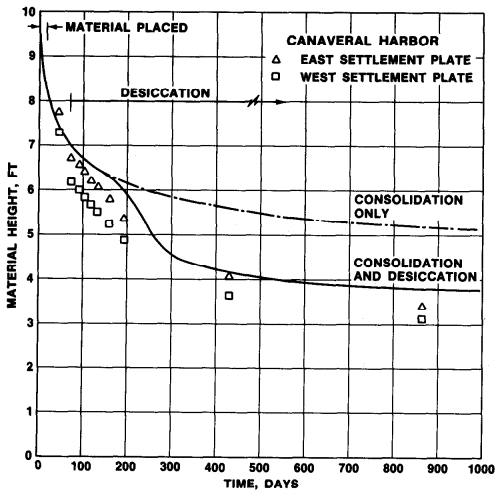 a)
a)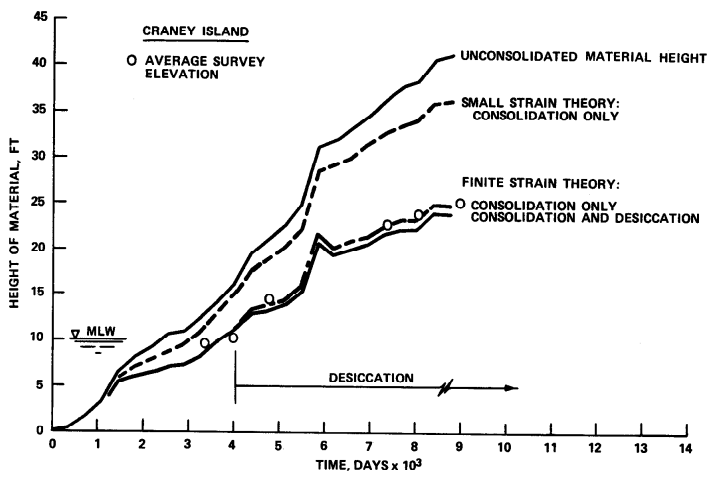 b)
b)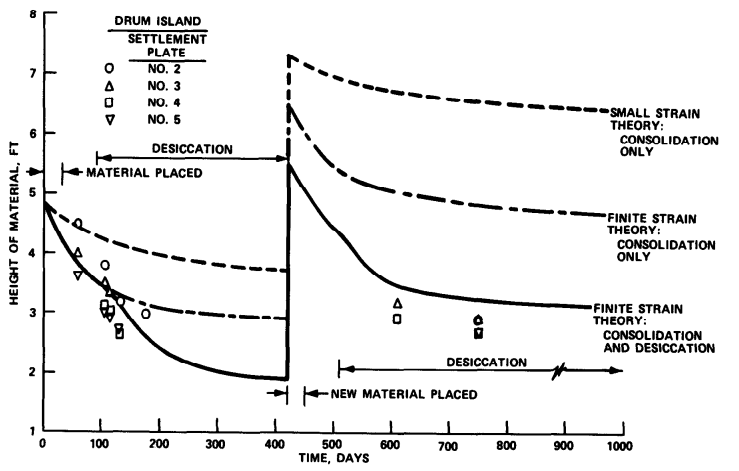 c)
c)
Validation of laboratory test procedures used to determine the soil consolidation properties utilized in the model was conducted by Cargill (1986, https://erdc-library.erdc.dren.mil/jspui/handle/11681/13047) using laboratory testing on soils from three dredged material disposal sites.
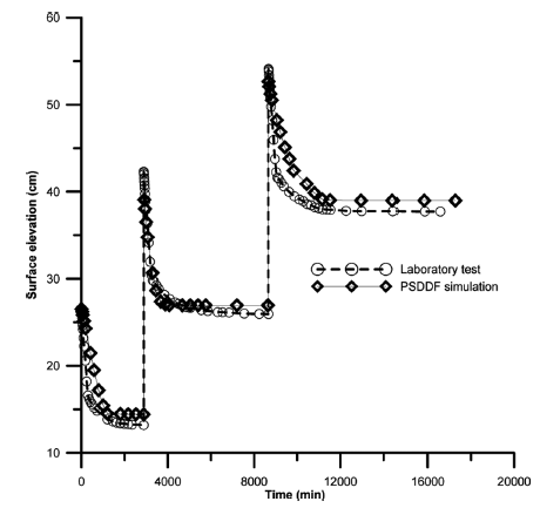
Lee et al. (2013) https://www.tandfonline.com/doi/abs/10.1080/1064119X.2012.680680, examined two case studies, comparing PSDDF model predictions to both a lab study and to updated filling at Craney Island Dredged Material Management Area (CIDMMA) near Norfolk, Virginia. Comparison between the model simulations and the laboratory test are shown below.
Currently, no Software Revision Discussion is available.