



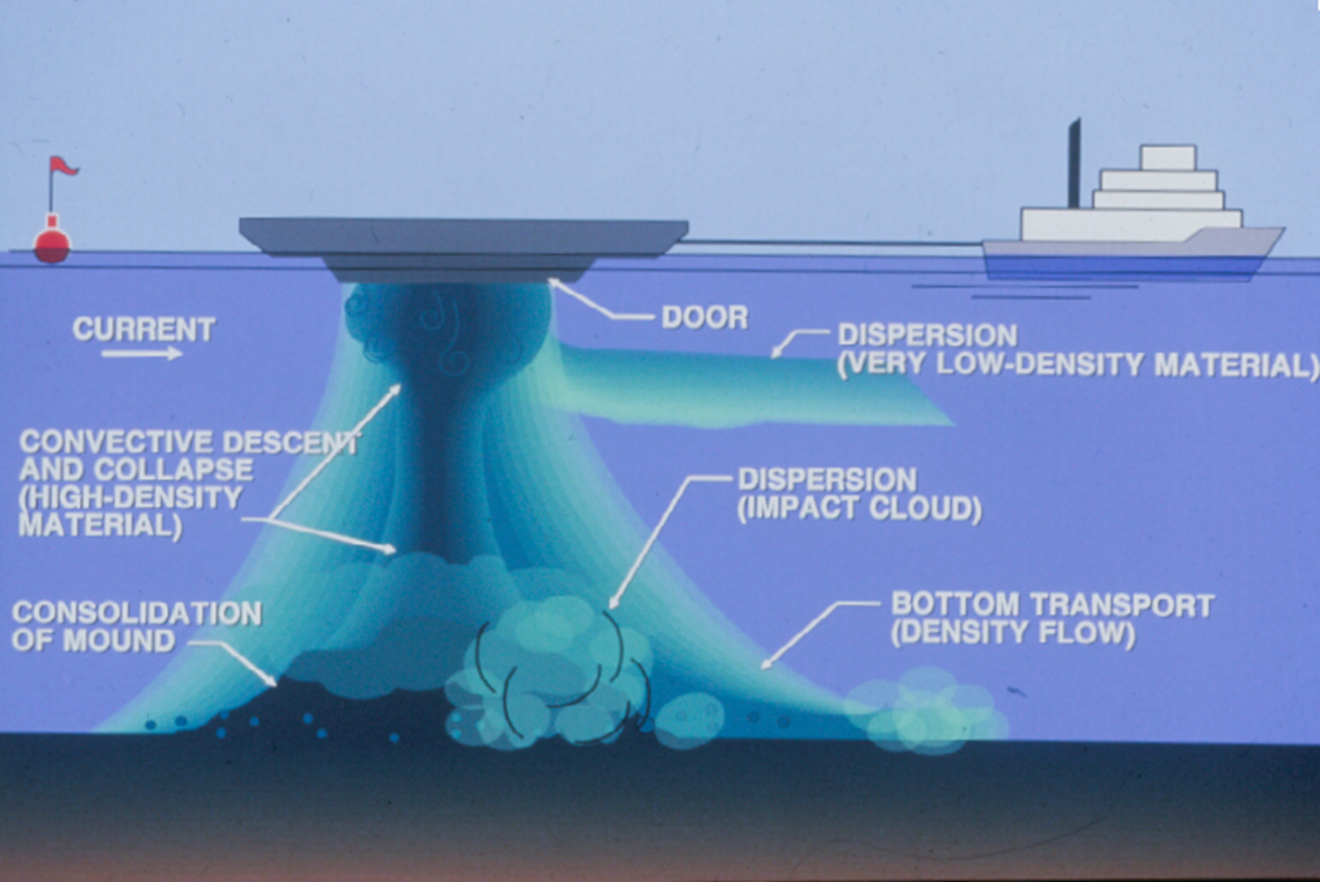
The STFATE model simulates the short-term fate of dredged material discharged from a barge/dump scow or hopper dredge in open water. The model predicts the movement of dredged material from an instantaneous discharge as it falls through the water column, collapses, spreads and deposits over the bottom, and then is transported and diffused by the ambient current as a plume of fluid with dissolved constituents and suspended solids. Short-term fate of dredged material disposed in open water is an integral part of assessing water-column environmental impacts. The model can provide an estimate of concentrations in the receiving water as well as the initial deposition pattern of material on the bottom. Estimates of water column concentrations are often needed to determine mixing zones and placement sites dimensions. The initial deposition pattern of material on the bottom is required in long-term sediment transport studies that assess the potential for erosion, transport, and subsequent sedimentation of the material.
Keywords: STFATE, dredged material, open water disposal, dump scow/barge, hopper, model
Point of Contact: Paul.R.Schroeder@usace.army.mil
Current Version: 5.01
The STFATE modeling software is available at no charge. The STFATE model Version 5.01 is available to run in either a DOS-based operating environment or a 16-bit Windows environment such as Windows XP. Both software packages are available as self-extracting executable files and can be downloaded from https://dots.el.erdc.dren.mil/products.cfm?Topic=model&Type=drgmat. Until STFATE can be updated, the DOS package must use a DOS emulator such as DOSBox to operate STFATE on Windows based 64-bit operating systems. DOSBox can be downloaded at https://www.dosbox.com. Alternatively, 16-bit Windows STFATE package can be run on older Windows operating systems such as Windows XP or older Windows operating systems.
Currently, no Documentation is available.
Koh, R.C.Y. and Y.C. Chang (1973). "Mathematical model for barged ocean disposal of waste," Technical Series EPA 660/2-73-029, U.S. Environment Protection Agency, Washington, DC. https://nepis.epa.gov/Exe/ZyPURL.cgi%3FDockey%3D93000B5O.TXT&ved=2ahUKEwiy5o-ajYSNAxVVRTABHcO8NGsQFnoECBsQAQ&usg=AOvVaw1QSIrRc7OtHITv3LgR7eNS
Brandsma, M.G. and D.J. Divoky (1976). "Development of models for prediction of short-term fate of dredged material discharged in the estuarine environment," Contract Report D-76-5, U.S. Army Engineer Waterways Experiment Station, Vicksburg, MS; prepared by Tetra Tech, Inc., Pasadena, CA. https://erdc-library.erdc.dren.mil/bitstreams/600d4836-738a-4141-8fd4-7f7191a00865/download
Bokuniewicz, H. J., J. Gilbert, R.B. Gordon, J.L. Higgins, P. Kaminsky, C.C. Pilbeam, M. Reed, and C. Tuttle (1978). "Field study of the mechanics of the placement of dredged material at open-water disposal sites. Vol. 1: Main text and Appendices A-I," Technical Report D-78-7, U.S. Army Engineer Waterways Experiment Station, Vicksburg, MS. https://apps.dtic.mil/sti/tr/pdf/ADA292918.pdf
Johnson, B. H. (1990). "User's guide for models of dredged material disposal in open water," Technical Report D-90-5, U.S. Army Engineer Waterways Experiment Station, Vicksburg, MS. https://erdc-library.erdc.dren.mil/bitstreams/81b728f8-7890-4ef8-e053-411ac80adeb3/download
Johnson, B.H. and M.T. Fong (Feb 1995). “Development and verification of numerical models for predicting the initial fate of dredged material disposed in open water; Report 2, Theoretical developments and verification results” (TR DRP-93-1), U.S. Army Engineer Waterways Experiment Station, Vicksburg, MS. https://erdc-library.erdc.dren.mil/server/api/core/bitstreams/81b728f8-7873-4ef8-e053-411ac80adeb3/content
EPA/USACE. 1998. Evaluation of dredged material proposed for discharge in waters of the U.S. – Testing manual. EPA-823 -B-98 -O04, Washington, D.C. https://dots.el.erdc.dren.mil/guidance/itm/ITM_Appendix_C.pdf
Currently, no Community Test Cases are available.
Currently, no Software Revision Discussion is available.